
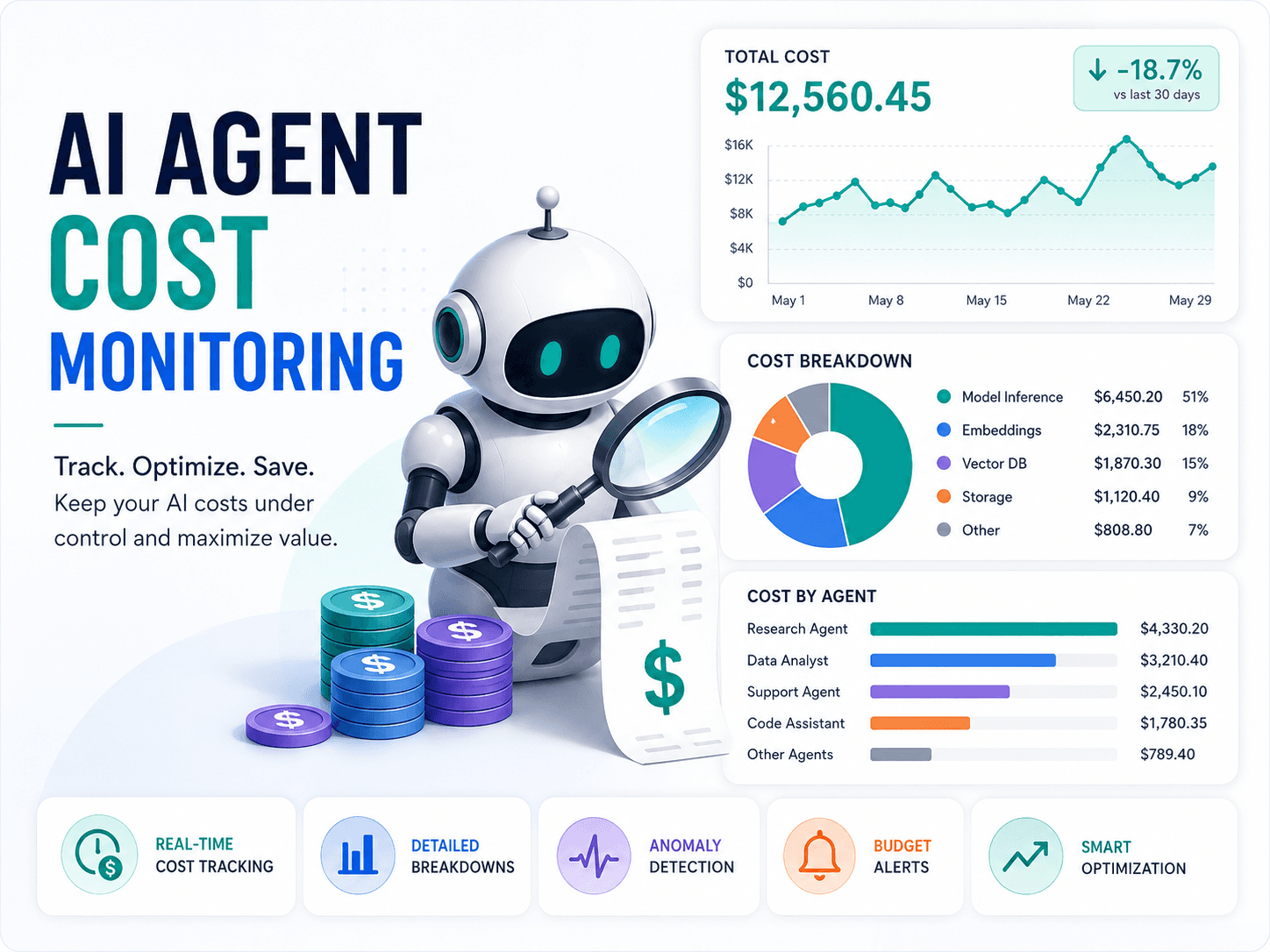
Here is the short answer: the model API bill is usually the smallest surprise. A production agent costs what its tokens cost, multiplied by how many times it loops, plus observability, evaluation and the engineering time to keep it honest. Anthropic's own engineering team has published the multiplier: a single agent uses roughly 4 times the tokens of a chat interaction, and a multi-agent system uses about 15 times.
An AI agent, in cost terms, is a loop. It reads context, thinks, calls a tool, reads the result, and repeats until the task is done. Every pass re-sends a growing conversation to the model, and you pay for every token, every time.
Token prices are falling, yet agent bills keep rising
The unit economics look wonderful on paper. The Stanford AI Index 2025 found that inference cost for a GPT-3.5 level system dropped more than 280-fold between November 2022 and October 2024. Epoch AI's analysis puts the decline at anywhere from 9x to 900x per year depending on the capability you're matching.

So why do finance teams keep flagging the AI line item? Because consumption grows faster than prices fall. Cheaper tokens invite longer contexts, more retries and more ambitious workflows. A team paying 10 times less per token but running 40 times more of them has a bigger bill, not a smaller one.
The real cost stack has four layers
Model inference. The headline layer. On Anthropic's current pricing, a frontier model runs at 5 dollars per million input tokens and 25 dollars per million output tokens, while the mid-tier sits at 3 and 15 and the small tier at 1 and 5. OpenAI's pricing follows a similar tiered shape. The trap is that agents are input-heavy: each loop iteration re-reads the whole history, so input tokens dominate and prompt caching (which discounts repeated context by up to 90 percent) becomes a first-order lever.
Orchestration overhead. Tool definitions, retrieved documents, tool results and system prompts ride along on every call. A 2,000-word answer can sit on 50,000 tokens of scaffolding.
Observability and evaluation. You cannot run an agent you cannot see. Tracing platforms such as LangSmith charge per seat plus per trace beyond a free allowance, and a busy agent generates traces on every step of every task. Add scheduled evaluation runs, which are themselves model calls, and monitoring often lands at 10 to 20 percent of inference spend.
People. Someone has to review traces, tune prompts, update evals when the model version changes, and investigate the week the agent quietly started taking twice as many steps per task.
Cost per task is the only number that matters
Per-token prices tell you almost nothing about your economics. The number to instrument from day one is cost per completed task: total spend across the loop, divided by tasks that finished correctly. It captures the retries and failed runs that per-request dashboards hide. If a support agent resolves a ticket for 0.40 dollars against a 6 dollar human handling cost, the conversation with your CFO is short. If nobody knows the figure, the conversation is about switching it off.
Cost per task also exposes your cheapest levers: routing easy steps to a small model, capping loop iterations, caching aggressively, and trimming tool definitions the agent never uses. Teams that do this before scaling, ideally with experienced AI deployment and scaling support, routinely cut per-task cost by half without touching quality.
FAQ
How much does it cost to run an AI agent in production?
Expect roughly 4 times the token spend of an equivalent chatbot for a single agent and around 15 times for multi-agent systems, per Anthropic's engineering data, plus 10 to 20 percent on top for observability and evaluation. The honest unit is cost per completed task, which most teams can bring under a pound for well-scoped workflows.
Will falling model prices fix my agent costs?
No. Prices per token are falling fast, but agent consumption typically grows faster because cheaper tokens encourage longer loops and more ambitious tasks. Caching, routing and loop caps deliver savings that price cuts alone will not.
Should I self-host models to cut costs?
Only at serious scale. Below a few million tokens a day, API pricing almost always beats renting GPUs once you count utilisation gaps and ops time. Revisit the maths when volume is high and steady.
Your five-step cost checklist
1. Instrument cost per completed task before launch, not after the first alarming invoice.
2. Enable prompt caching and measure the hit rate weekly.
3. Route steps by difficulty: small models for classification and extraction, frontier models for reasoning.
4. Cap loop iterations and set per-task token budgets so a stuck agent fails cheaply.
5. Budget 10 to 20 percent of inference spend for observability and evals, and review traces monthly.
If you want these numbers modelled for your own workflow before you commit budget, BeyondPixl Studio runs cost-per-task audits as part of its AI deployment and governance engagements. Book a scoping call and bring your ugliest invoice.