
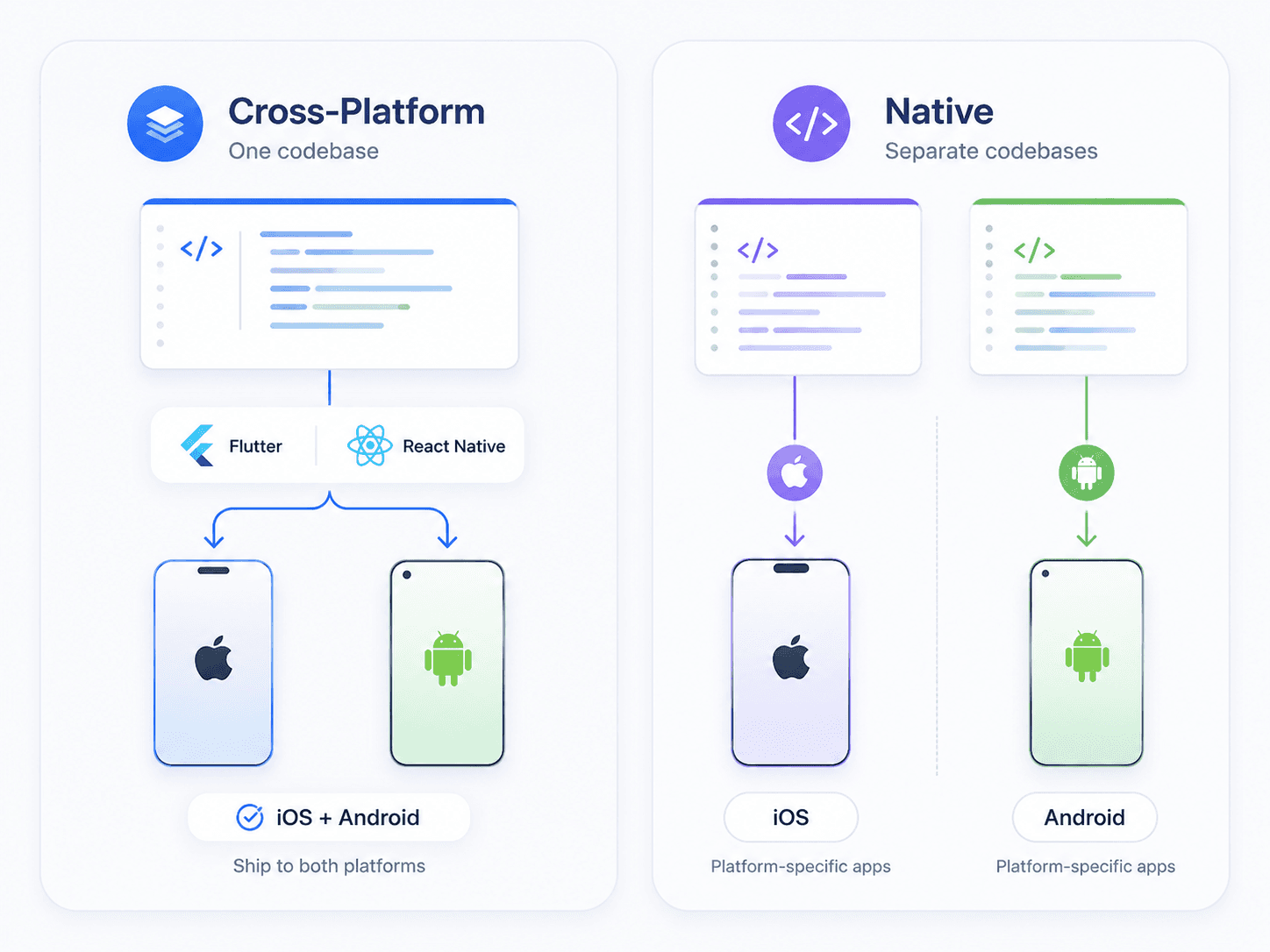
If you're deciding between one shared codebase and two native apps, here's the honest answer: cross-platform is meaningfully cheaper for most products, because you're paying one team to build and maintain one codebase instead of two. Agencies love to quote precise savings figures, often somewhere between 40 and 60 percent, but those numbers come from vendor marketing rather than audited studies, so treat them as directional. The real question isn't whether cross-platform saves money. It does. The question is whether your app sits in one of the categories where it still loses.
Cross-platform development means writing your app once, in a framework like Flutter or React Native, and shipping it to both iOS and Android. Native development means building each app separately in Swift and Kotlin. The frameworks compile down to real UI or draw their own, so the result is genuinely close to native for most screens.
The savings are real, and so is the ceiling
The economics are straightforward. Shopify spent five years building its mobile apps in React Native and reported 86 percent average code sharing across platforms, with some apps reaching 99 percent. One feature team ships to two stores. That's where the savings live: fewer engineers, one hiring pipeline, one set of tests, and no more explaining why the Android release is three weeks behind iOS.
Performance used to be the trade you made for that. It mostly isn't any more. Shopify's engineers got their flagship app's screen loads from 1,400ms down to under 500ms at P75 inside React Native, and React Native's New Architecture removed the old asynchronous bridge that caused most of the classic jank. For a typical business app with lists, forms, payments, and dashboards, users cannot tell the difference.
Where native still wins, honestly
Cross-platform loses in a few predictable places, and it's better to know them before you commit than after.
First, anything that leans hard on the platform itself. Heavy camera and video processing, AR, background audio, widgets, watch apps, and the newest OS features on launch day all live closer to the metal. Every one of these means writing platform channels or native modules anyway, and if half your app is native glue code, the shared codebase stops paying for itself.
Second, scale with deep platform demands. Airbnb famously sunset React Native in 2018 after two years of investment, not because the framework was slow but because maintaining the bridge between worlds at their scale cost more than it saved. That lesson still holds: if you already employ large iOS and Android teams, cross-platform can add a layer rather than remove one.
Third, games and graphics-intensive work, where you'll want a games engine or native rendering from day one.
Choosing a framework is the easy part
Both major frameworks are mature. The Stack Overflow Developer Survey 2024 puts Flutter at 9.4 percent of developers and React Native at 8.4 percent, with older options like Xamarin and Cordova fading well behind.

Flutter tends to suit design-heavy apps that should look identical everywhere; React Native suits teams that already write React and want to share talent with the web. What matters more than the logo is whether the team building it has shipped the platform-specific edges before. That's the judgement we apply in our own cross-platform app development work: the framework choice takes an afternoon, the boundary decisions take experience.
FAQ
Is cross-platform really cheaper than native?
Yes, for most apps, because one codebase replaces two. Published vendor estimates vary widely and aren't independently audited, so budget on the structural saving of a single team rather than a precise percentage.
Will users notice the difference?
For typical business apps, no. Shopify reports sub-500ms screen loads and over 99.9 percent crash-free sessions in React Native. Users notice slow screens, not frameworks.
When should I go native instead?
When your core feature depends on deep platform access, when you're shipping graphics-heavy experiences, or when you already run large native teams and the abstraction layer would add cost rather than remove it.
Before you decide, run this checklist
1. List every feature that touches hardware, background processing, or new OS capabilities.
2. Estimate what share of the app that list represents; above roughly a quarter, price the native option seriously.
3. Audit your team's existing skills, since React experience shifts the maths towards React Native.
4. Prototype your riskiest screen in the framework before committing the roadmap.
5. Plan the escape hatch: how you'd go native for one module without a rewrite.
If you'd like a second opinion before you commit a year of budget to either path, BeyondPixl runs framework selection assessments that prototype your highest-risk feature in both approaches and give you a costed recommendation within two weeks. Book a cross-platform feasibility review and decide with evidence rather than vendor percentages.