
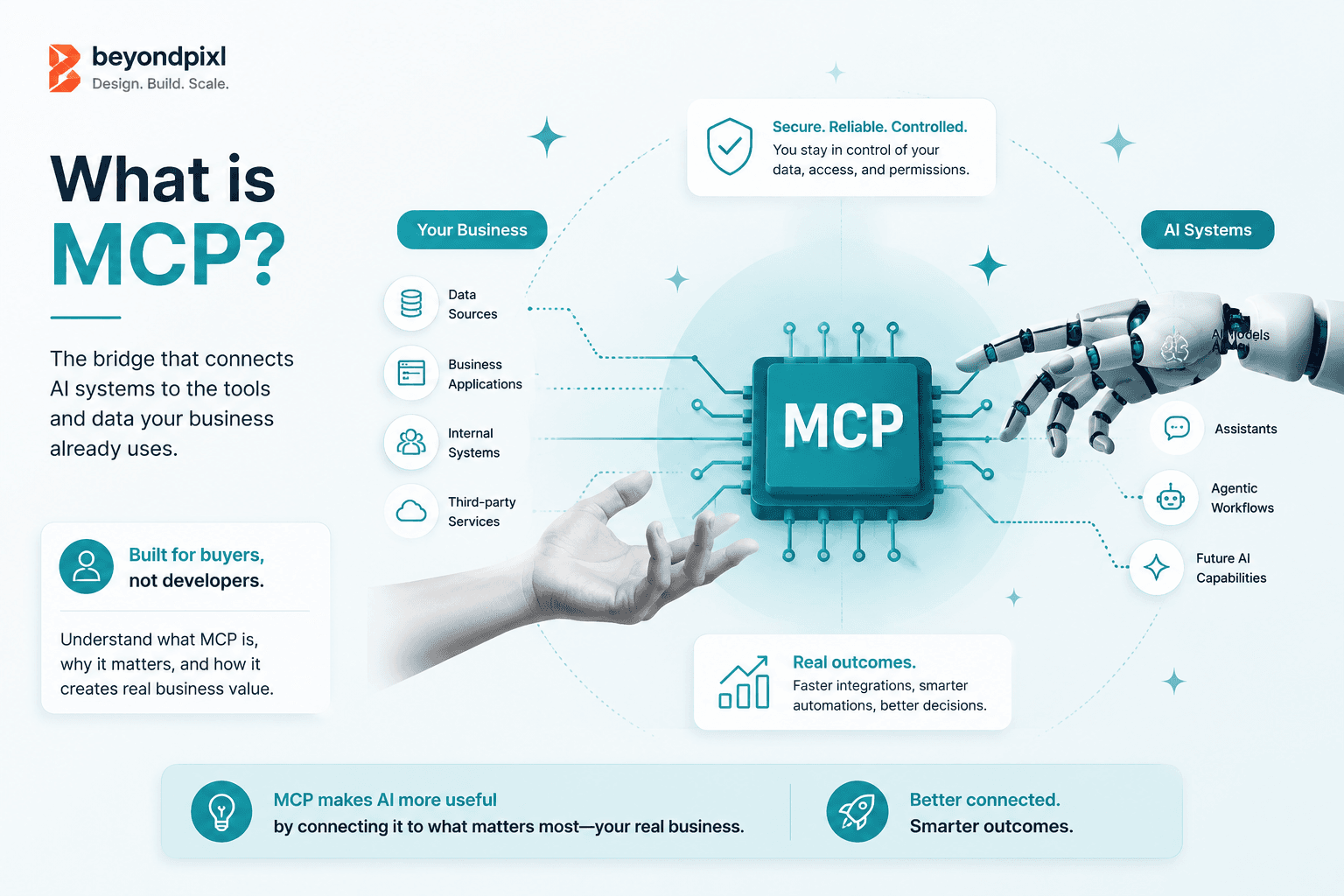
MCP, the Model Context Protocol, is a shared standard that lets AI assistants connect to your business tools without a custom integration for every pairing. Think of it as the USB-C of AI software: one common plug instead of a drawer full of proprietary cables. If a vendor's product "supports MCP", it means their AI can talk to any tool that also speaks the standard, and any AI can talk to their tool. That single fact changes what you should ask for in your next software evaluation.
MCP was released as an open standard by Anthropic in November 2024. It defines how an AI model requests data or actions from an external system, and how that system responds, in a format every participating product understands.
Why a plumbing standard became a buying issue
Before MCP, connecting an AI assistant to a CRM, a document store, or a ticketing system meant a bespoke integration each time. Five assistants and twenty tools could mean a hundred separate connectors, each one built, secured, and maintained by somebody you were paying. With a shared standard, each side implements the protocol once and the combinations come free.

The chart above is illustrative, but the maths behind it is not. Point to point integrations grow multiplicatively; standardised ones grow additively. That difference is why the ecosystem grew so quickly. By December 2025, Anthropic reported more than 10,000 active public MCP servers and over 97 million monthly SDK downloads, and Claude alone shipped with over 75 MCP powered connectors.
It is not an Anthropic product any more, and that matters
A reasonable worry with any vendor created standard is lock-in. Here the trajectory points the other way. In December 2025, Anthropic donated MCP to the Agentic AI Foundation under the Linux Foundation, whose platinum members include AWS, Google, Microsoft, and OpenAI. The protocol is now governed neutrally, the way HTTP or Bluetooth are.
Adoption crossed vendor lines well before that. OpenAI supports MCP in its Agents SDK, Google's Gemini API works with MCP tools, and Microsoft lets you extend Copilot Studio agents with MCP servers. When you buy software that speaks MCP, you are not betting on one AI lab winning.
What MCP support actually buys you
Three practical things. First, optionality: if your assistant of choice changes next year, your integrations survive the switch. Second, speed: connecting a new tool becomes configuration work measured in days, not a development project measured in months. Third, negotiating leverage: a vendor whose product exposes an MCP server is easier to replace, and they know it, which tends to keep renewal conversations honest.
There is a flip side buyers should hear plainly. An MCP connection gives an AI real access to real systems, so the security questions get sharper, not softer. The official MCP documentation is explicit that hosts must enforce user consent and access controls. Ask any vendor how permissions are scoped, what the AI can write as opposed to read, and where audit logs live. This is exactly the sort of groundwork we cover in enterprise AI integration engagements, because the protocol standardises the plumbing, not the judgement about what should flow through it.
FAQ
Does MCP replace our existing APIs?
No. MCP sits on top of your existing APIs and databases as a translation layer that AI models understand. Your systems stay as they are; an MCP server simply describes what they can do in a standard format.
Is MCP safe for enterprise use?
It can be, with the same discipline you apply to any integration. The protocol itself requires explicit user consent for tool access, but scoping permissions, isolating credentials, and logging AI actions remain your responsibility and your vendor's.
Should MCP support be a hard requirement in procurement?
For any tool you expect AI assistants to use, yes, or at least a committed roadmap item. Given adoption by OpenAI, Google, and Microsoft, a vendor with no MCP story is choosing isolation.
Your next five moves
1. List the tools your teams most want AI assistants to reach, and rank them by value.
2. Ask each incumbent vendor whether they expose an MCP server today, and if not, when.
3. Add MCP support to your procurement checklist for new software.
4. Define read versus write permissions before any connector goes live.
5. Pilot one low-risk connection end to end, with audit logging switched on, before scaling.
If you want a second pair of eyes on that list, BeyondPixl Studio runs integration readiness reviews that map your current stack against the MCP ecosystem and hand you a prioritised connection plan. Book a readiness review and arrive at your next vendor negotiation knowing exactly what to ask for.