
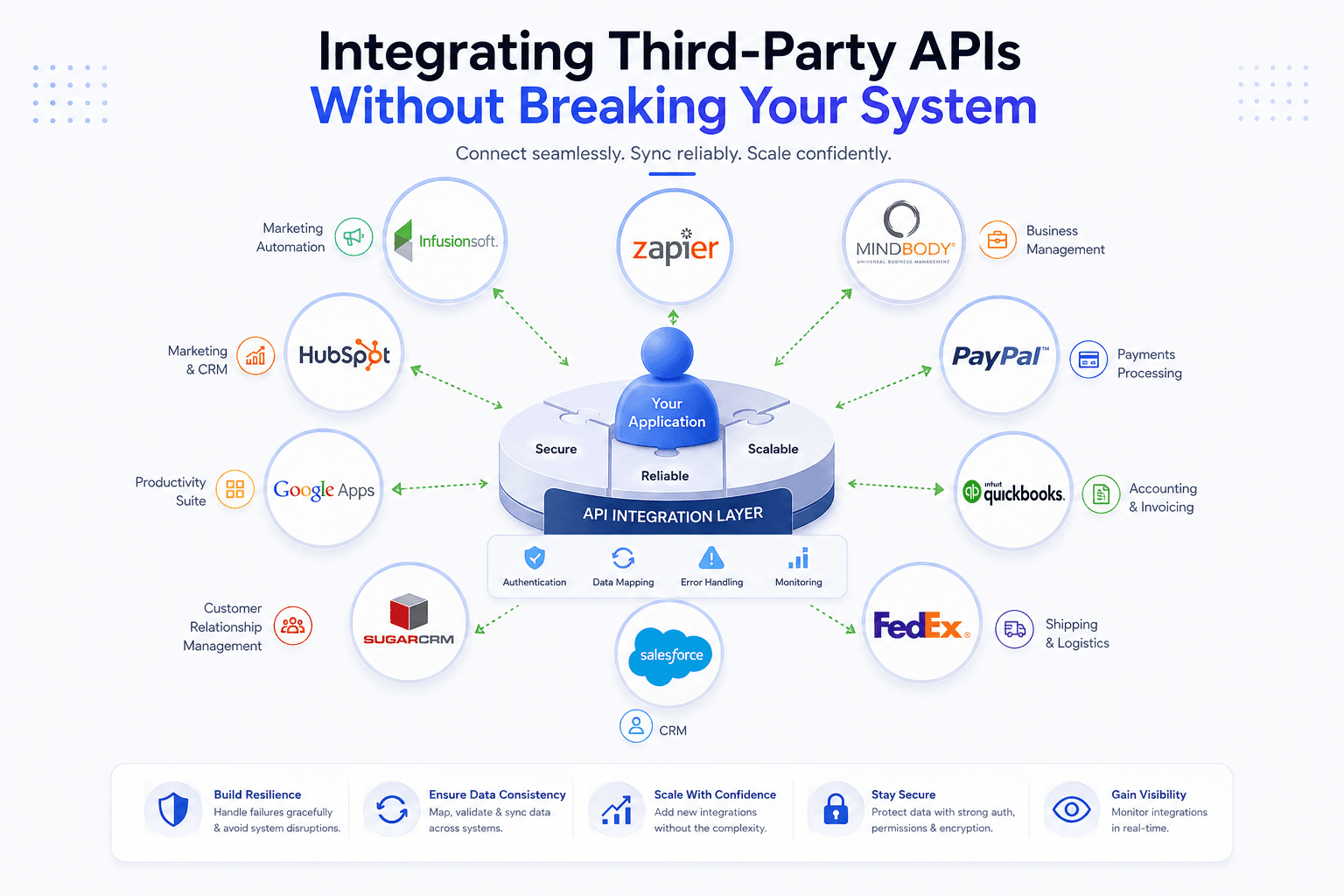
Your product depends on APIs you do not control, from payments through Stripe to core features running on an LLM provider, and those calls are becoming less dependable. Uptrends tracked more than 400 companies and found average weekly API downtime rose from 34 minutes in Q1 2024 to 55 minutes in Q1 2025. The question is no longer whether a provider will have a bad Tuesday. It is how much of your system that Tuesday is allowed to take down.
Third party API integration is the practice of connecting your application to an external service's API, such as payments, messaging, or AI models, so it can use capabilities you did not build in-house. Done well, it treats every external call as an unreliable network operation: bounded by a timeout, retried with care, and isolated so a provider failure degrades one feature instead of the whole system.
A provider outage should cost you a feature, not your system
The real damage pattern in a failing integration is not an error message but resource exhaustion, where a slow dependency quietly consumes your threads, connection pools, and queue capacity until healthy parts of the system starve.
Late 2025 supplied the case study when a DNS race condition in DynamoDB's automation cascaded through AWS us-east-1 for roughly 15 hours, degrading dependent services from Snapchat to banking apps. Those companies did nothing wrong; their dependency failed and the failure propagated, at a measurable cost. Splunk and Oxford Economics estimate unplanned downtime costs Global 2000 companies $400 billion a year.
Timeouts, careful retries and idempotency make single calls safe
The most common integration bug is a missing explicit timeout, leaving client defaults of 30 seconds or infinity in charge. If a provider that normally answers in 200 milliseconds starts answering in 20 seconds, every request thread you have is soon parked waiting on it. The Amazon Builders' Library guidance on timeouts, retries, and backoff is the best free education here: set timeouts from measured p99 latency, and give each user-facing request a total budget shared by all its external calls.
Naive retries multiply your traffic exactly when a provider can least absorb it. AWS's retry with backoff guidance reduces the safe version to a few rules: retry only transient failures such as timeouts, 429s, and most 5xx responses, use exponential backoff with full jitter, enforce a retry budget, and retry at one layer only, since stacked retries across client, service, and queue turn one failed call into dozens of attempts.
Idempotency is what makes retrying safe at all. The nightmare case is a payment call that succeeds while the response times out on the way back, so a retry might charge the customer twice. Idempotency keys resolve the ambiguity: attach a unique key to each logical operation, and a provider that sees the same key twice returns the stored result instead of executing again. Stripe's idempotent requests work this way. Generate the key when the business intent is created, and persist it before sending, so a crashed process can recover and re-send safely.
Circuit breakers and webhook design contain sustained failures
The circuit breaker pattern handles a dependency that is properly down. It counts failures against a threshold, and once tripped, calls fail immediately instead of burning timeout budget or piling load onto a struggling provider, until probe requests after a cooldown close the circuit again. Libraries such as resilience4j and Polly give you the mechanism; the hard part is deciding what each feature does while its circuit is open. Most dependencies can degrade gracefully, by queueing payments or serving cached data, but fraud and KYC checks must fail closed and hold signups for review. That decision draws on the same thinking as good API design at your own boundaries.
Webhooks, where the provider calls you, hide the subtle bugs. Serious providers deliver at least once, not exactly once, so duplicates and out-of-order events are the contract. Stripe's webhook documentation states that failed deliveries are retried with exponential backoff for up to 72 hours. The receiving pattern that survives production: verify the signature against the raw request body, dedupe by event ID, enqueue the work and return a 2xx within seconds, fetch authoritative object state before acting on anything money-shaped, and reconcile on a schedule for deliveries that never arrived.
The revenue riding on integrations keeps growing
APIs are now load-bearing revenue, not glue code. Postman's 2025 State of the API report found 65% of organisations earn revenue from their APIs, and among those, 25% say APIs contribute more than half of total revenue, as the chart below shows.

The failures that erode this revenue are usually quiet ones, and reliable backend systems defend against each specifically. Pin API versions, automate credential rotation, respect Retry-After headers, and test failure paths with fault injection tools such as Toxiproxy, because provider sandboxes are always healthier than the real thing.
FAQ
How do you handle third-party API failures gracefully?
Wrap every external call in an explicit timeout, retry transient errors with capped exponential backoff and jitter, and place a circuit breaker in front of each dependency so sustained failures fail fast. Then define a per-feature fallback such as cached data or queued work.
Should you retry failed API calls automatically?
Yes, for transient failures such as timeouts, 429s, and most 5xx responses, but only with exponential backoff, jitter, and a hard cap on attempts. Never retry client errors like 400, never retry non-idempotent operations without idempotency keys, and retry at one layer only.
Your integration hardening checklist
Set explicit connect and read timeouts derived from the provider's measured p99 latency.
Add retry with backoff, full jitter, and a retry budget, at one layer only.
Attach idempotency keys to every mutating call and persist them before sending.
Put a circuit breaker on each dependency and decide what degraded looks like per feature.
Verify webhook signatures on raw bodies, dedupe by event ID, enqueue, respond fast, and reconcile on a schedule.
None of this is exotic. It is a short list of patterns applied consistently, and it is what separates a provider's bad Tuesday from your worst week. BeyondPixl Studio designs and builds production-grade AI products and the integration layers beneath them, so if your roadmap depends on APIs you cannot control, talk to our engineering team about an integration resilience review.