
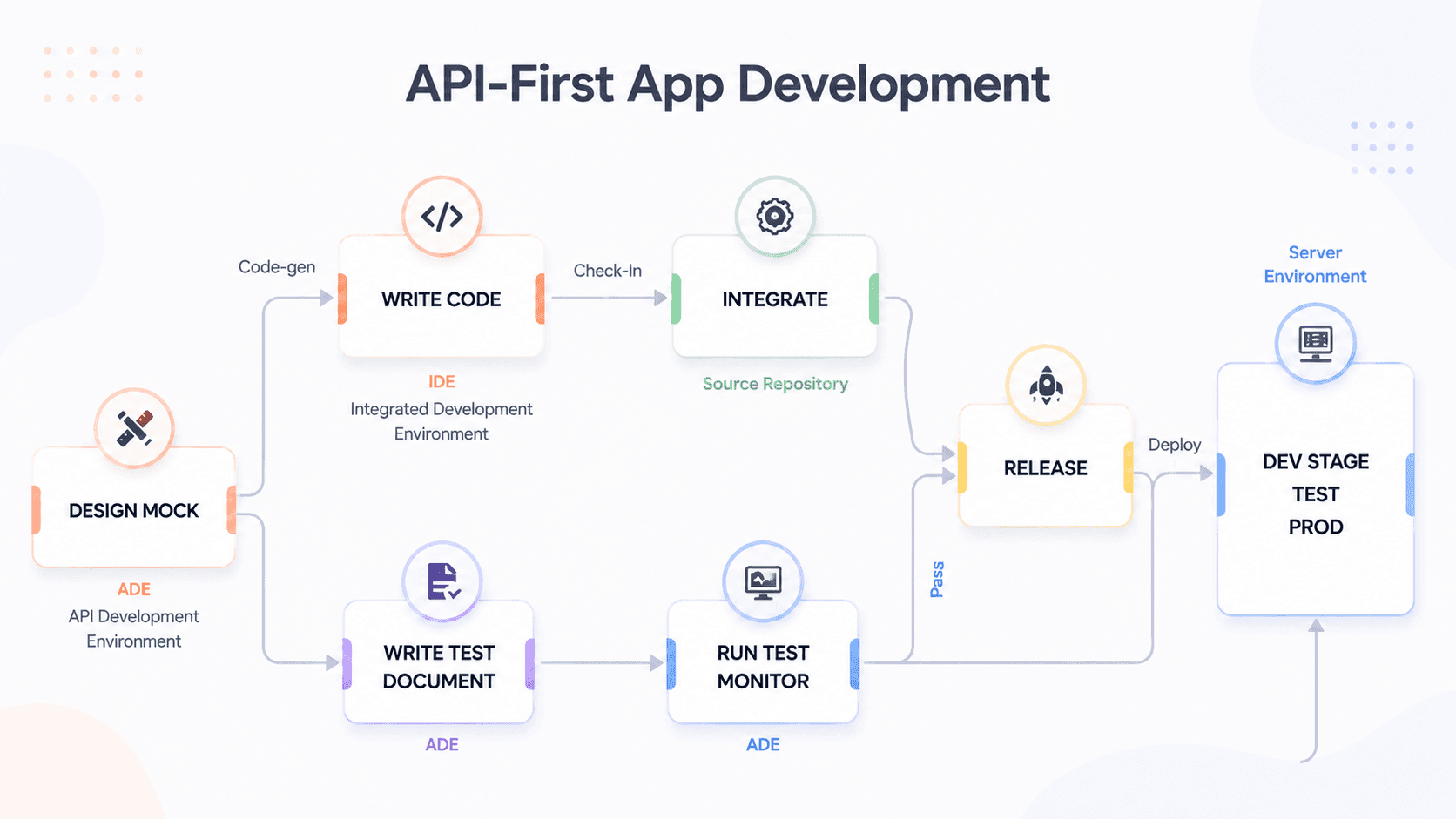
Most APIs are never designed. They accumulate, one endpoint at a time, shaped by whatever the frontend needed that sprint. The cost stays invisible until a mobile app, a partner or an AI agent needs the same data and finds an interface nobody would have chosen on purpose. The industry response has been decisive: 83.2% of teams in Postman's 2025 State of the API report now follow some level of an API-first approach.
API first design means defining the API contract, meaning the endpoints, data shapes and behaviours, before writing any implementation code, and treating that interface as a product in its own right. The contract, usually an OpenAPI specification, becomes the source of truth from which code, tests, mocks and documentation are generated or validated. Every consumer, including your own frontend, integrates against the same designed interface.
Your API is the one decision you cannot easily reverse
Databases can be swapped and monoliths split without users noticing. A public API is different, because once an external consumer integrates, every field name and status code becomes a promise, and breaking it breaks someone else's production system. That is why Stripe treats its API as infrastructure, running a translation layer so that integrations pinned to versions from 2017 still work today.
Within API-first there is a practical split between code-first, which generates the specification from implementation code, and contract-first development, which writes the specification before any code exists. Code-first feels quicker, but the API's shape ends up dictated by implementation details. Swagger's comparison of the two approaches reaches the conclusion most practitioners do: design-first wins whenever an API has external consumers or multiple teams, because frontend, QA and documentation work can start from the spec in parallel. If the API will outlive the sprint that created it, contract-first is the safer default. In Postman's 2025 survey, 43% of fully API-first organisations earn more than a quarter of total revenue from APIs.
The adoption data shows this argument is already settled
Postman's annual reports track a steady climb: API-first adoption rose from 66% in 2023 to 74% in 2024, then reached 83.2% in 2025.

A new class of consumer raises the stakes. Gartner predicts that more than 30% of the growth in API demand will come from AI and LLM-based tools by 2026, yet Postman found only 24% of developers currently design APIs with agents in mind. A clean machine-readable contract is the entry ticket to that traffic.
Scalable API architecture is mostly about what you refuse to promise
Scalability conversations jump to load balancers and caching, but for APIs the tighter constraint is the contract itself, because every promise limits what you can change later. Expose behaviours, never internals: if responses mirror your database tables, every schema migration risks becoming a breaking change. Make additive change the only change, following Stripe's compatibility policy, where new optional parameters and fields are safe while renaming or removing anything is not. Paginate every list from day one, since Google's API design guidance makes pagination mandatory for list operations because retrofitting it breaks clients. Design errors as carefully as successes, with a machine-readable code, a human message and a request ID in every response. This is where API design discipline is most visible to the people integrating with you.
On versioning, the pragmatic mix for most teams is additive evolution as the default, a coarse URL version held in reserve, and a written policy defining exactly what counts as a breaking change, since consumers can plan around any scheme that behaves predictably.
A spec that is not enforced will quietly rot
An OpenAPI file in a wiki is documentation. The same file wired into CI is architecture. A working setup lints the spec on every change with a tool like Spectral, diffs it on every pull request so a removed field fails the build, runs contract tests to catch implementation drift, and generates SDKs, mocks and reference docs from the single contract. This tooling is what makes API-first cheaper over time, and in a distributed SaaS architecture the enforced contract becomes the boundary between services and between teams.
One honest caveat: contract-first adds upfront ceremony, and for a two-person startup validating an idea, code-first is the right trade. The mistake is letting a prototype's API become the product's API without passing through a design gate.
FAQ
Does API first design slow delivery down?
It adds days of upfront contract work but usually shortens total delivery for multi-consumer products. The spec unblocks parallel workstreams, and Postman's 2024 report linked API-first practice to faster API production.
How do I version an API without breaking clients?
Default to additive changes, meaning new optional fields, parameters and endpoints, which are backward-compatible by definition. When a break is unavoidable, use an explicit scheme such as URL versions or Stripe-style date-pinned versions, and publish a written policy defining what you count as breaking.
Adoption checklist
Choose a contract format, OpenAPI for REST, protobuf for gRPC, and keep specs in version control beside the code.
Write a one-page API style guide covering naming, pagination, error shape and auth, then encode it as Spectral lint rules running in CI.
Add breaking-change detection to pull requests so removed fields fail the build.
Publish a versioning and deprecation policy before your first external consumer signs up.
Review each new API as a product, with a real or role-played consumer in the room, before implementation starts.
The first two steps cost a sprint and compound from then on. At BeyondPixl Studio we design and build API-first platforms, from contract design and governance tooling to the services behind them, so if your API grew instead of being designed, talk to our engineering team about a contract audit before the next rewrite.