
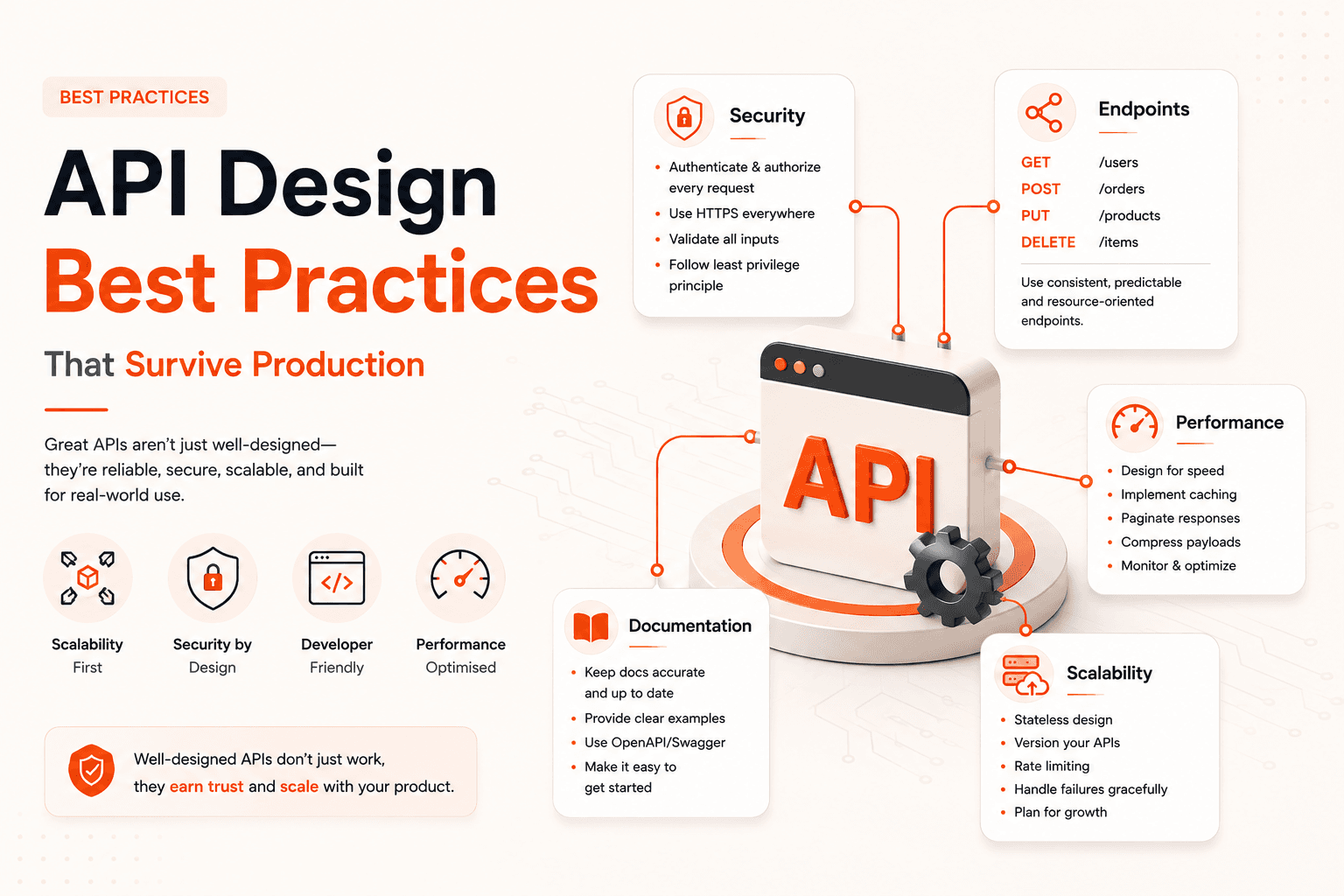
An API is the only part of your system you cannot quietly refactor. Rename an internal function and nobody outside your team notices. Rename a response field and a customer's checkout flow fails in production, usually at the worst possible hour. The Postman 2025 State of the API report found that 93% of teams run into inconsistent documentation, duplicated work, or APIs nobody can locate. Those are design failures, not tooling failures.
What is API design? API design is the practice of defining how an interface exposes data and operations to its consumers: the endpoints, request and response shapes, error formats, and the rules for changing them. A well-designed API behaves as a long-lived contract, predictable for the teams consuming it and still changeable for the team maintaining it.
Write the contract before the code
The highest-value habit in API work is drafting the interface as an OpenAPI specification before anyone implements it, then reviewing that document with the same rigour as an architecture decision. Implementations get rewritten all the time, whether through a framework migration or a service split during a microservices vs monolith re-evaluation, but the interface persists. Stripe has kept every API version compatible since 2011, which shows how seriously the strongest API businesses treat that permanence.
A written contract also removes the serial dependency between teams: frontend developers build against a mock generated from the spec while the backend is in progress, and QA writes contract tests from day one. Postman found 82% of organisations have adopted some level of an API-first approach, yet only 25% describe themselves as fully API-first.

The partial adopters in the middle are where most contract drift and breaking-change incidents happen, because writing specs occasionally is not the same as treating the spec as the artefact that gates a release.
Choose REST or GraphQL by problem, not preference
Postman found 93% of respondents use REST and 33% use GraphQL, with plenty of teams running both. That overlap is the real lesson: these are tools with different failure modes, not competing ideologies. REST wins on simplicity, HTTP-native caching, and per-endpoint rate limiting, while GraphQL lets clients name exactly the fields they need at the cost of harder caching and rate limiting. GraphQL earns that operational cost when many clients with different data needs hit the same backend, which is the aggregation problem it was built for, and IBM notes that enterprise GraphQL adoption has grown fastest there. A pattern that holds up well in production: REST for public and partner surfaces, GraphQL as an internal aggregation layer for product frontends, and gRPC where service-to-service latency genuinely matters.
Treat versioning and consistency as one promise
Putting /v1/ in a path is syntax. The substance is a written answer to one question: which changes are allowed without a version bump? Stripe defines this precisely: adding endpoints, optional parameters, or new response properties is backward compatible, while renaming a field, changing a type, or making an optional field required never is. Copy that discipline into your own guidelines, make only additive changes within a version, and pair any unavoidable break with a deprecation policy that has real dates. Version as rarely as you can, because each parallel version roughly doubles your test surface.
Consistency is the other half of the promise. Integrators leave when userId in one endpoint becomes user_id in another and uid in a third. Use plural nouns without verbs in paths, one casing convention everywhere, and structured errors following RFC 9457 Problem Details so every failure carries a machine-readable code and a request ID. Prefer cursor-based pagination for growing collections, as the Microsoft REST API guidelines recommend, and require idempotency keys on unsafe operations so a retried payment returns the original result rather than a duplicate charge.
Design authorisation in, then document from the spec
The security data is blunt. Salt Security's 2025 research found 99% of organisations experienced API security issues in the past twelve months, with 95% of attacks arriving through authenticated sessions. The attacker held valid credentials, and authorisation, not authentication, was the layer that failed. That is why Broken Object Level Authorisation ranks first on the OWASP API Security Top 10: GET /orders/{id} confirms the caller is logged in but never checks the order belongs to them. The defences are design-level: enforce ownership checks in a shared layer rather than per-endpoint discipline, define explicit response schemas so serialising a whole database row cannot leak internal fields, rate limit per consumer, and keep a live API inventory, because unknown endpoints are where breaches start.
Documentation deserves the same structural fix. Generate reference docs from the same OpenAPI document that drives your contract tests, so the two cannot drift apart silently, then write the parts no generator can: a quickstart that gets a developer to a first successful call in under five minutes, honest guides for auth flows, webhooks, and retries, and a public deprecation policy stating exactly how much notice integrators will get.
FAQ
When should I choose GraphQL over REST?
Choose GraphQL when many clients with different data needs consume the same backend and over-fetching is a measurable problem. REST remains the better default for public APIs and service-to-service calls because of HTTP caching and simpler rate limiting.
What is the most common API security vulnerability?
Broken Object Level Authorisation, ranked first by OWASP. An API verifies that a caller is authenticated but not that they may access the specific object requested, and since most attacks arrive through authenticated sessions, authentication alone stops very little.
Your API design checklist
Draft the OpenAPI contract first and review it like an architecture decision.
Pick REST, GraphQL, or gRPC per problem, not per preference.
Write down your compatibility rules and deprecation notice period before v1 freezes, then standardise naming and error formats everywhere.
Enforce object-level authorisation in a shared layer and maintain a live API inventory.
Generate docs from the spec, add a five-minute quickstart, and wire contract tests into CI.
Good API design comes down to making a small number of promises and keeping them for years. If you are approaching a v1 freeze or untangling a messy v2 migration, talk to the engineering team at BeyondPixl Studio about a contract review before the interface hardens.