
Discovery has no demo day. Its output is decisions, a few diagrams and a risk register, which is why it gets squeezed the moment a deadline appears on the calendar. That squeeze is expensive: a joint study by McKinsey and Oxford University covering more than 5,400 IT projects found that large software projects run 45% over budget on average and deliver 56% less value than predicted, with unclear objectives near the top of the cause list. Those are exactly the failures discovery catches while they are still cheap.
What the technical discovery process actually covers
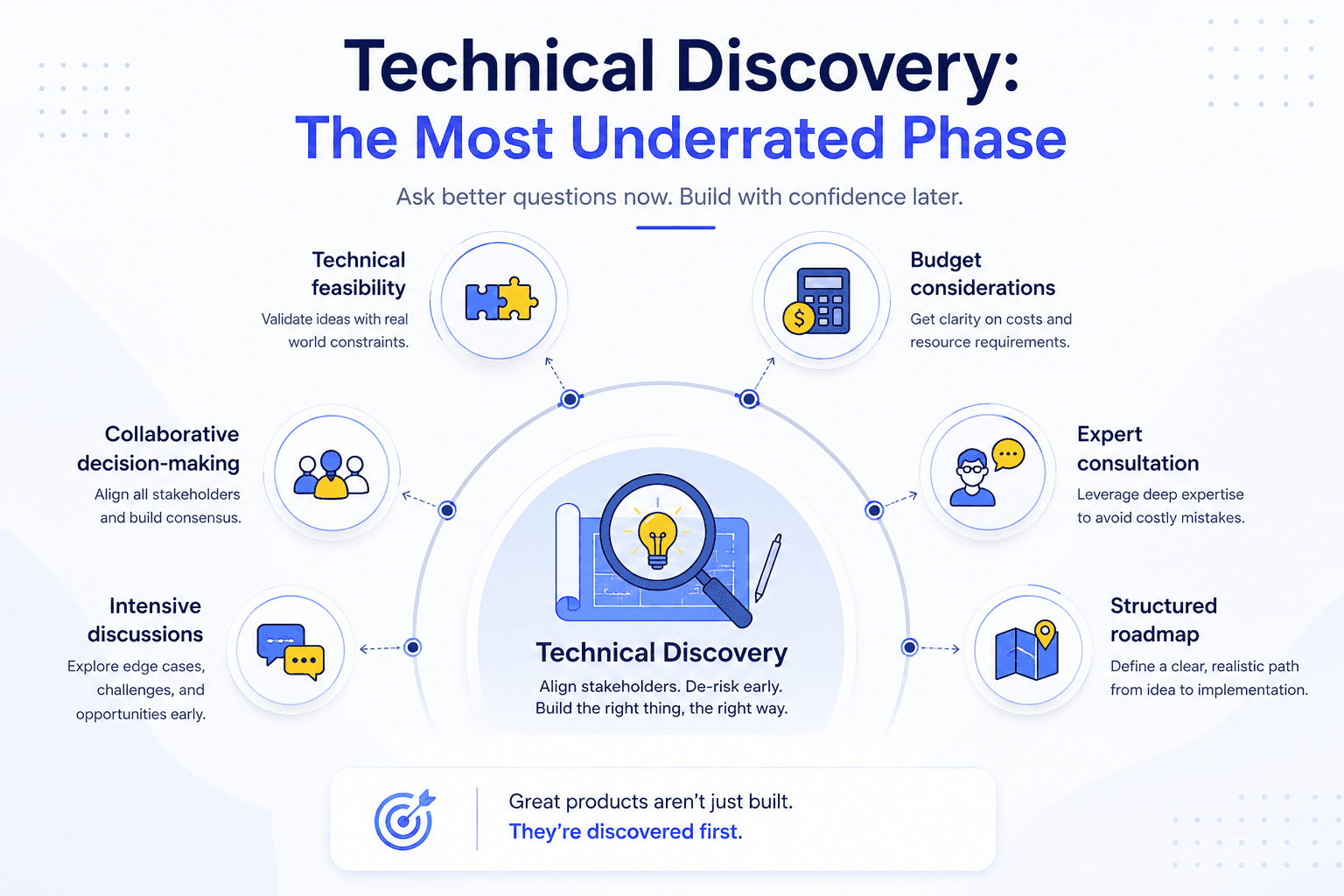
The technical discovery process is a short, structured phase before development in which a team maps the requirements, the existing systems, the data, the integrations, the risks and the candidate architectures for a build. Its output is decisions and documents rather than code, typically produced in one to four weeks. It exists to answer one question before production work starts: what are we actually building, and what could break it?
That is the tidy definition. The lived version involves interviewing the operations person who knows why the legacy cron job exists, and settling the multi-tenancy argument on a whiteboard, where it costs nothing, rather than in a database migration, where it costs weeks. A requirements document alone covers perhaps a third of proper project scoping; the rest is system archaeology, integration reality checks, data assessment and a ranked risk register.
Skipping discovery borrows time at a punishing interest rate
The economic case is well documented. NASA's error cost escalation study measured what a requirements error costs to fix depending on when it is found. If catching it during the requirements phase costs 1 unit, the same error costs 3 to 8 units in design, 21 to 78 units during integration and test, and anywhere from 29 to over 1,500 units once the system is operational. The curve is exponential, and PMI's Pulse of the Profession research shows where it bites: 47% of unsuccessful projects fail to meet their goals because of inaccurate requirements management. Not weak engineers, not the wrong framework, but requirements nobody pinned down.

The same PMI research programme estimated that organisations waste roughly US$1 million every 20 seconds globally through poor project performance. Against numbers like these, structured requirements gathering and validation is inexpensive insurance.
Spike the risks, then write documents people actually read
The highest-value activity in the phase is the technical spike: a small, time-boxed experiment that converts "we think" into "we know". A workable rule is that every risk rated "could kill the project" gets a spike, and everything else gets a documented assumption with a named owner. A spike during discovery costs hours; the same finding during development costs sprints. Teams that build on unchecked guesses convert them into technical debt, which 62% of professional developers named their single biggest frustration in the 2024 Stack Overflow Developer Survey.
Discovery output should not be a slide deck that dies in a shared drive. DORA's research links high-quality documentation to 25% higher team performance. The artifact set that gets used in practice is short and single-purpose: a context diagram, one-page Architecture Decision Records, a draft data model with migration notes, a living risk register, a non-functional requirements sheet and an estimate with confidence bands. ADRs matter most, because six months in, the reason the system is event-driven exists in writing rather than in the memory of an engineer who has left. Long specifications rot, while short documents get read, challenged and updated.
A two-week discovery sprint beats a zero-week one
The standard objection is that startups cannot spare a month for planning. They do not need to, because discovery scales down. Week one is for understanding: stakeholder interviews and hard constraints, system archaeology, and a risk register naming the top three risks. Week two is for validating and deciding: parallel spikes on those risks, a comparison of candidate architecture decisions recorded as ADRs, and a final day producing a banded estimate and a first-month build plan.
That is ten working days with two or three people. Industry guides on the discovery phase price it at roughly 5 to 10% of total project budget, a small slice against the 45% average overrun McKinsey documented. The phase pairs naturally with MVP development, because discovery identifies which corners are safe to cut and which decisions, such as the auth model and tenancy, are nearly impossible to reverse after launch. Two cautions keep it honest: discovery that runs past a month is usually procrastination, and discovery without the build engineers in the room becomes a handoff, which is where context dies.
FAQ
How long should a technical discovery phase take?
One to four weeks covers most product builds. A two-person, two-week sprint handles a typical startup project, while large enterprise integrations may justify four to six weeks. Beyond that, time-box it and decide.
Do agile teams still need a discovery phase?
Yes, because agile changes how much you plan up front, not whether you validate assumptions. Sprints will not reveal that your data model cannot support tenancy or that a vendor API lacks a feature you depend on, and ceremonies alone do not fix inaccurate requirements.
Your discovery checklist
Time-box the phase: two weeks for most builds, four for heavy integrations.
Interview every stakeholder class, then read the real code, dump the real schema, and list every integration with its owner.
Write a ranked risk register with an owner and a validation plan per risk.
Spike the top three risks against real systems, and record architecture decisions as one-page ADRs.
Estimate in confidence bands tied to the open risks, never as a single number.
None of this requires heroics, only two weeks of discipline before the exciting part starts. At BeyondPixl Studio we run a structured discovery sprint before every engagement, because a landmine found on a whiteboard costs nothing. If you are planning a build, talk to our engineering team about scoping a two-week discovery sprint before the budget is committed.