
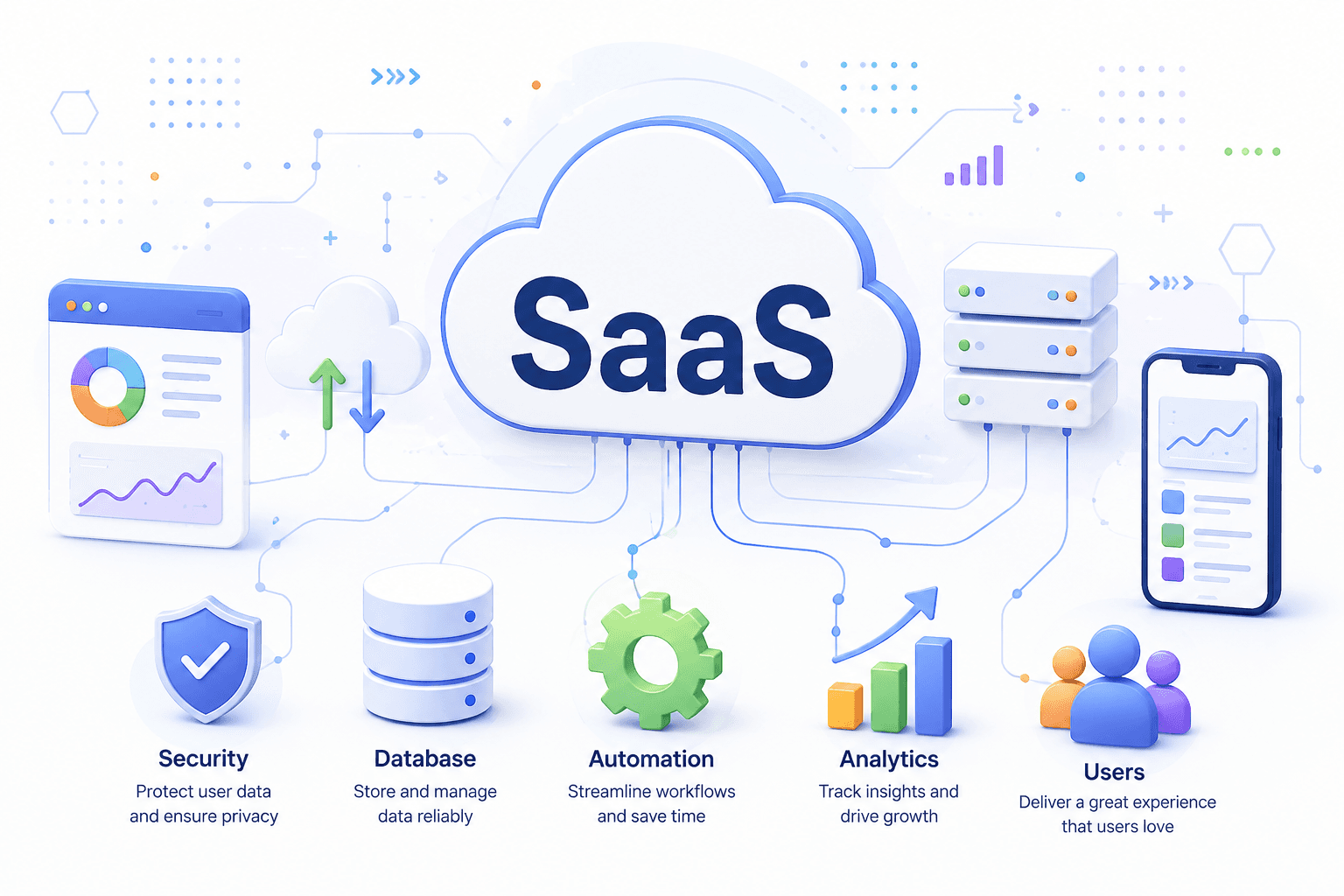
Most SaaS products don't fail in the demo. They fail three months after launch, when a customer's messy import breaks the pipeline, an enterprise prospect asks for SSO, and the team discovers that tenant data was never properly isolated. Production readiness is not a phase you schedule after the MVP; it is a small set of decisions about tenancy, billing, deployment, and security that are cheap in week one and brutally expensive to reverse in month nine.
What a production-ready SaaS product actually is
A production-ready SaaS product is a multi-tenant application that can onboard, serve, and bill paying customers without manual intervention, and without leaking one tenant's data to another. In concrete terms it has isolated tenant data, automated deployments with tested rollback, monitoring that surfaces failures before customers report them, and a billing pipeline that handles renewals, failed cards, and cancellations correctly. It does not mean built for infinite scale; it means safe and reliable at the scale you can plausibly reach in the next twelve months.
Scope follows the same logic. Pick one revenue-bearing workflow and build only that plus authentication and billing. Industry benchmarks put a launch-ready SaaS MVP at 8 to 12 weeks, and teams that ship an MVP in 6 weeks manage it by cutting scope aggressively, never by cutting the production fundamentals.
Tenancy is the one decision you cannot cheaply reverse
Multi-tenant architecture is the foundation of MVP SaaS architecture, and retrofitting it is close to a rewrite. The AWS Well-Architected SaaS Lens documents the trade-offs across pooled, schema-per-tenant, and siloed models; the short version is that a shared schema fits most products at MVP stage, while database-per-tenant isolation belongs to regulated industries and large enterprise deals.
Start with a shared schema and a tenant_id column on every table, enforced with PostgreSQL row-level security so a forgotten WHERE clause cannot expose another customer's records. Postgres is the sensible default, being the most-used database among professional developers at 55.6%. The pooled model is also the reversible one: a high-value tenant can later be moved to a dedicated database, whereas merging siloed tenants back together is far harder.
Choose a boring SaaS tech stack and treat the API as a contract
Your stack should be optimised for iteration speed and hiring, not novelty. Stripe's Developer Coefficient study found engineers already lose about 42% of their working week to technical debt and bad code, and exotic infrastructure makes that worse. A sane default in 2026: one mainstream backend language the team writes quickly, managed PostgreSQL, React, a single cloud provider, and Stripe or a merchant of record for payments. Follow the twelve-factor principles, and good cloud architecture at this stage becomes mostly restraint: managed services, one region, and no Kubernetes until a measured bottleneck forces it.
The API deserves the same discipline, because today's frontend contract will later be hit by integrations and customers' own scripts. Consistent naming, versioning from the first release, pagination on list endpoints, and idempotency keys on anything that moves money will save you from silently breaking paying customers. Stripe's API reference is the standard worth studying, and we cover the deeper patterns in our guide to API design.
Security, billing, and the pipeline are launch blockers
The pre-launch security bar is not SOC 2; it is the fundamentals. Hash passwords with a standard library, use OAuth or OIDC for sign-in, test tenant isolation with real cross-tenant requests, and keep secrets out of the repository. OWASP ASVS Level 1 is a realistic checklist for a small team.
For billing, use the provider's hosted flows and handle webhooks properly, because failed payment retries, proration, and cancellation states are where revenue quietly leaks. Median net revenue retention for private SaaS companies sits around 101 to 102%, and a pipeline that fumbles renewals drags that number down before anyone notices. For deployment, the 2024 DORA report found elite teams deploy 182 times more frequently than low performers with roughly eight times lower change failure rates, so speed and stability move together. The minimum: every merge runs tests, deploys and rollbacks each take one command, and error tracking plus uptime alerts exist from day one.
Keep the effort in proportion, though. In CB Insights' analysis of startup failure post-mortems, running out of cash (38%) and no market need (35%) tower over everything else, while a genuinely poor product accounts for just 8% of failures. Make the boring choices good enough that engineering never blocks learning what the market wants.

FAQ
Should I start with single-tenant or multi-tenant architecture?
Start multi-tenant with a shared schema, a tenant_id on every table, and row-level security enforced in Postgres. Moving a large tenant onto dedicated infrastructure later is straightforward; merging siloed tenants back together is a genuine migration project.
What separates an MVP from production readiness?
An MVP proves people want the product; production readiness means it can hold paying customers' money and data safely without manual babysitting. Tenant isolation, automated deploys, and working billing belong in the MVP, while SLAs and certifications can wait.
Your build checklist
Write down the single workflow a customer will pay for and cut everything else from v1.
Model tenancy explicitly from day one: tenant_id everywhere, row-level security on.
Pick a mainstream stack your team already writes quickly, on one cloud, with a versioned API contract.
Stand up CI/CD, error tracking, and a rehearsed one-command rollback before feature work.
Integrate hosted billing, test the ugly paths, and run an OWASP ASVS Level 1 pass before inviting customers.
None of this needs heroics, only sequencing: product depth on top, boring and well-tested infrastructure underneath. At BeyondPixl Studio we design and ship production-grade SaaS products with founders and engineering teams. Talk to our engineering team about your tenancy and stack decisions before the expensive ones get made for you.