
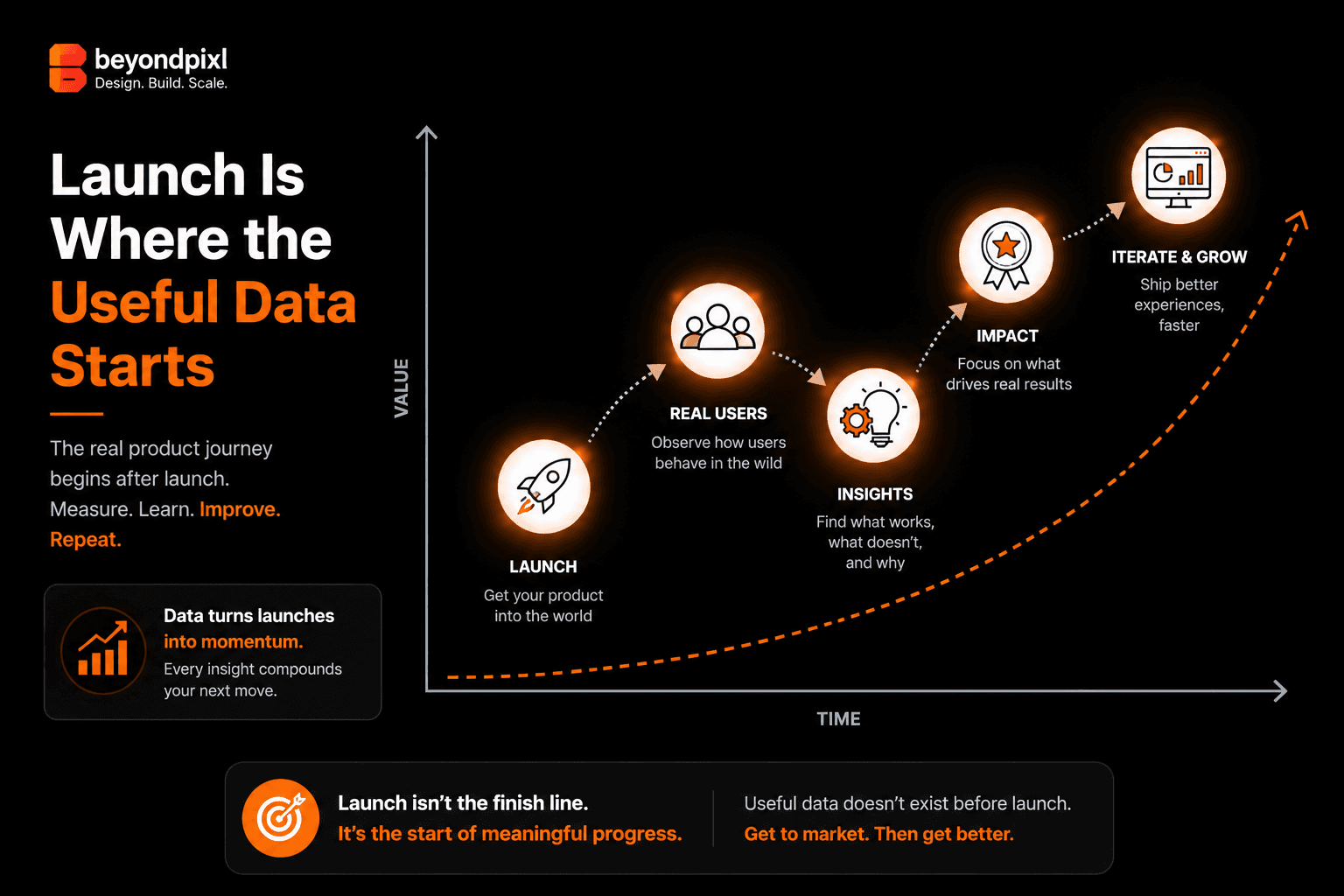
Everything you believed about your product before launch was a guess. Some guesses were well researched, some were founder instinct, but none of them had been tested against people spending their own time and money. The moment you ship, that changes. Launch is not the finish line of product development; it is the first day you have evidence instead of opinion. Teams that treat it that way iterate their MVP into a business. Teams that treat launch as the goal tend to stall precisely when the useful information starts arriving.
Post-launch iteration means running a deliberate loop after shipping: instrument the product, watch what real users do, form a hypothesis about the biggest gap, ship a change, and measure again. It is the discipline that separates a launched product from a growing one.
Your pre-launch assumptions are worse than you think
This is not pessimism, it is measurement. Microsoft's experimentation platform team, which ran thousands of controlled experiments across Bing and other products, found that only about one third of ideas actually improved the metrics they were designed to improve. A third made no measurable difference and a third made things worse. These were ideas from experienced teams with deep user research, and they still lost two times out of three. Ron Kohavi's follow-up work on unexpected experiment results is a catalogue of confident predictions that real users quietly demolished.
If seasoned platform teams misjudge two thirds of their bets, a founder's launch-day roadmap deserves the same humility. The honest position is that your backlog is a stack of hypotheses waiting for data that did not exist until you shipped.
Most of what you built will sit unused, and that is a signal
Pendo analysed feature usage across hundreds of software products and found that 80% of features are rarely or never used, an overhang it valued at roughly $29.5 billion in wasted development spend among public cloud companies. You cannot know which 20% of your product is carrying the load until people are actually in it.
That knowledge is commercially decisive. CB Insights' analysis of startup post-mortems found the most common reason startups fail is building something the market does not need. The cruel part is that "no market need" rarely looks like silence. It looks like a launch spike, polite sign-ups, then flat retention. Only usage data over weeks reveals it, and only iteration fixes it while there is still runway left.

The chart above is illustrative rather than measured, but the shape is the point. Before launch your stock of real behavioural evidence is close to zero however much research you did. After launch it compounds weekly, provided you are instrumented to capture it and staffed to act on it.
Iteration is how you actually reach product-market fit
Marc Andreessen's argument that product-market fit is the only thing that matters is often quoted and less often operationalised. Fit is not a launch attribute; it is something you converge on by shipping, measuring retention cohorts, and adjusting. As the a16z team later put it, you earn fit progressively, starting with a small set of users who genuinely rely on you, then widening from there.
In practice that convergence needs a steady cadence: weekly analytics reviews, a prioritised experiment queue, and engineering capacity reserved for changes the data demands rather than features the roadmap promised. This is exactly the work a post-launch growth and iteration engagement exists to do, and it is why the first 90 days after launch usually matter more than the 90 days before it.
FAQ
How soon after launch should we start iterating?
Immediately, but on evidence rather than reflex. Spend the first two to four weeks confirming your instrumentation works and gathering baseline retention and activation numbers, then ship your first data-driven change within the first month.
What metrics matter most right after launch?
Activation and retention beat vanity numbers. Track how many new users reach the product's core value moment, and what percentage return in week two and week four. Downloads and sign-ups tell you about your marketing, not your product.
Do we need A/B testing from day one?
No. With early-stage traffic, most tests will not reach significance. Start with cohort retention analysis and user interviews, and introduce controlled experiments once you have enough weekly active users to detect real differences.
Your first 90 days after launch
1. Verify analytics instrumentation covers activation, retention and your core value action.
2. Establish baseline cohort retention for weeks one, two and four.
3. Interview ten real users, focusing on those who churned.
4. Ship one measurable improvement per week against your biggest drop-off point.
5. Review the numbers weekly and reprioritise the backlog on evidence, not the original roadmap.
If your product is live and the data is piling up faster than your team can act on it, BeyondPixl Studio runs post-launch iteration retainers that turn that data into a weekly shipping cadence. Book a 90-day iteration planning call and bring your retention numbers.