
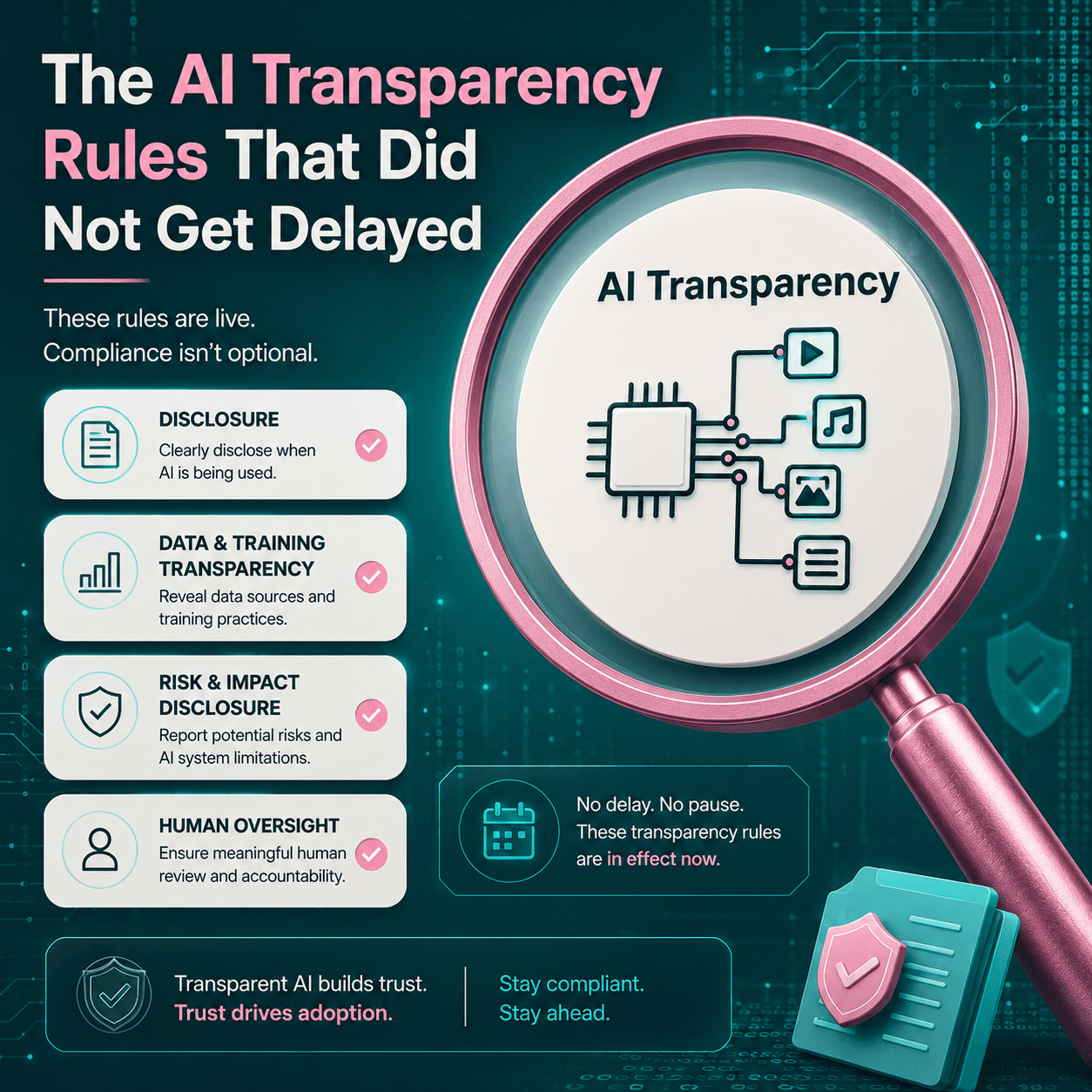
If your team read the headlines about the EU AI Act being pushed back and quietly deprioritised compliance, you have a problem. The digital omnibus agreement did delay the high-risk obligations, moving Annex III systems to 2 December 2027 and AI embedded in regulated products to 2 August 2028. But Article 50, the transparency rules, was left exactly where it was. It applies from 2 August 2026. That date has now arrived, and any product with a chatbot, generated content, or a synthetic voice in front of EU users is in scope today.
Article 50 is the part of the Act that governs disclosure rather than risk management. It says people must know when they are talking to a machine, when content was generated or manipulated by AI, and when they are exposed to emotion recognition or biometric categorisation. It is deliberately broad, and it applies regardless of whether your system counts as high risk.
What the omnibus changed, and what it deliberately kept
The confusion is understandable. In May 2026, EU legislators reached a provisional agreement on the digital omnibus that reshuffled the AI Act timetable. High-risk obligations for standalone Annex III systems, things like recruitment screening and credit scoring, slipped from 2 August 2026 to 2 December 2027. High-risk AI inside regulated products moved to 2 August 2028.
Most coverage led with the delay. Far fewer pieces mentioned that the transparency obligations were untouched, which means the original date in Regulation 2024/1689 still stands. The earlier milestones already passed without drama: prohibited practices and AI literacy duties applied from 2 February 2025, and general purpose AI model obligations from 2 August 2025. Transparency is simply the next domino, and it did not move.

The chart above shows the shape of the problem. Teams tracking only the longest bar have twenty months of slack. Teams with a customer-facing assistant or a content pipeline had none.
Four duties that apply to ordinary products, not just risky ones
The Commission's guidelines on Article 50, published this June, spell out four practical duties. First, interactive systems must disclose that they are AI at the point of first contact, not in a terms page. If a reasonably observant user could mistake your assistant for a human, you must tell them. Second, providers of generative systems must mark synthetic audio, image, video, and text output in a machine-readable format so it is detectable as artificially generated.
Third, deployers must label deepfakes, meaning content that depicts real-seeming people, places, or events, even where nobody intended to deceive. Fourth, AI-generated text published to inform the public on matters of public interest must be disclosed as such. Guidance from Greenberg Traurig notes the editorial exemption is narrow: a human skim-read of AI drafts does not qualify, only genuine editorial responsibility does.
Breaches carry fines of up to 15 million euros or 3 percent of worldwide annual turnover, whichever is higher. That is not the headline 35 million euro tier, but it is far more than most disclosure banners cost to build.
What a sensible compliance pass looks like
The good news is that Article 50 work is mostly engineering, not legal restructuring. Disclosure states in the UI, watermarking or metadata in the generation pipeline, and an inventory of where AI touches your users. The Commission has also published a voluntary Code of Practice on transparency of AI-generated content; signing up is optional, but it is the clearest route to demonstrating compliance.
This is exactly the sort of gap a structured governance review catches early. If you are shipping AI features without a map of which obligations attach to which surface, a short engagement on AI deployment, scaling and governance will usually surface the exposure in days rather than months.
FAQ
Did the EU AI Act get delayed or not?
Parts of it did. High-risk obligations moved to December 2027 and August 2028 under the digital omnibus. The Article 50 transparency obligations were not delayed and apply from 2 August 2026.
Does Article 50 apply to companies outside the EU?
Yes, if your AI system or its output reaches users in the EU. Like the GDPR, the Act's reach follows the user, not your registered office.
Is watermarking every output really required?
Providers of generative systems must ensure outputs are marked in a machine-readable way, with limited exceptions for assistive editing tools. The voluntary Code of Practice describes accepted technical approaches.
Your five-step check before the regulator does it for you
1. Inventory every surface where users interact with AI or see AI-generated content.
2. Add clear disclosure to chatbots and voice agents at first contact.
3. Implement machine-readable marking for generated audio, image, video, and text.
4. Define a labelling policy for deepfake-style content and public-interest text.
5. Assign an owner and evidence trail for each duty, ready for an audit request.
If that list reads like a backlog you have not started, BeyondPixl Studio runs focused Article 50 readiness reviews as part of its AI governance practice: book a transparency gap assessment and get a prioritised fix list within a week.