
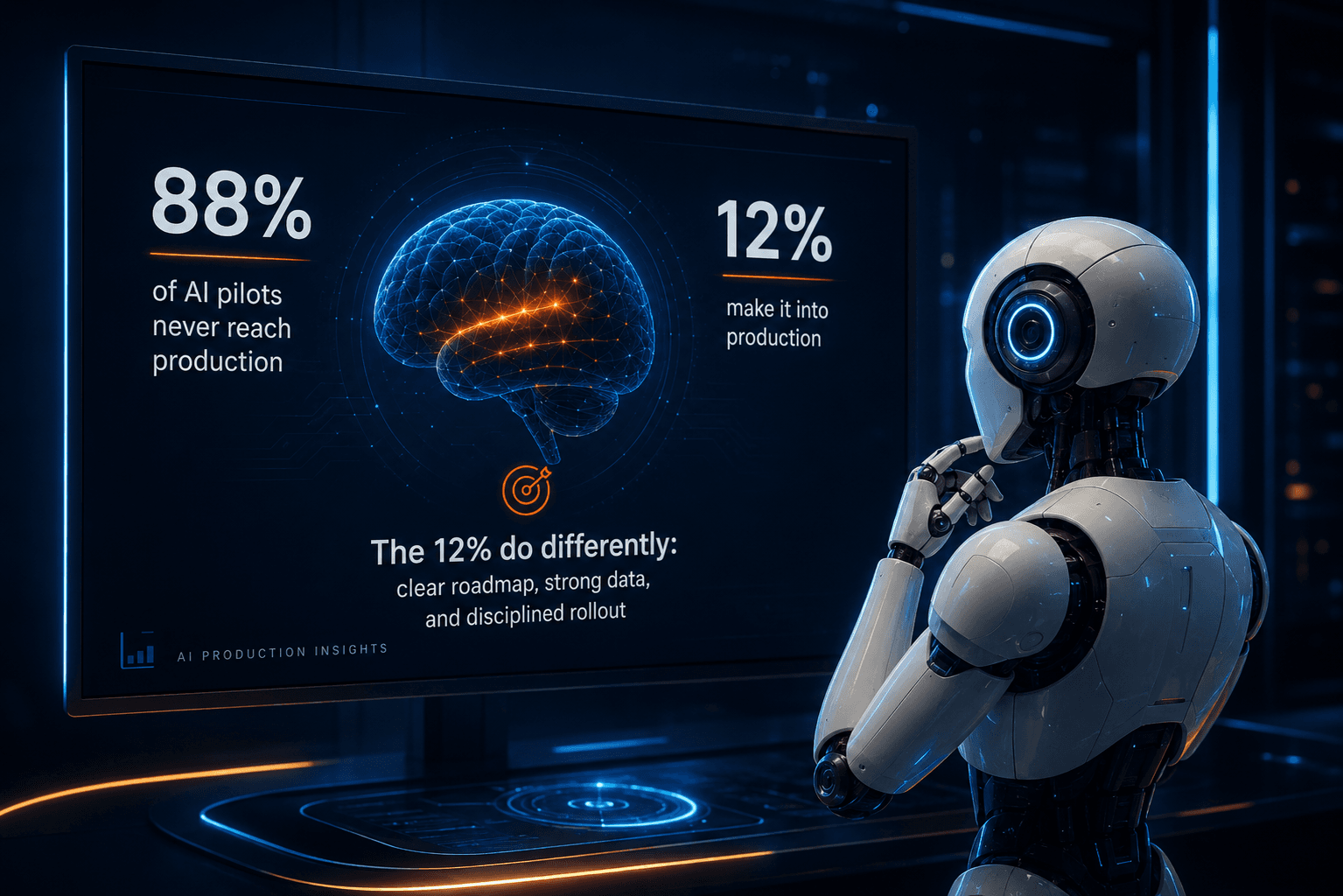
Most AI pilots fail for a boring reason: the organisation was never ready to run them. Research from IDC, published in partnership with Lenovo, found that 88% of AI proofs of concept never make it to production. For every 33 pilots a company launches, roughly four graduate. The model usually works fine in the demo. What breaks is everything around it: the data pipelines, the workflow it was meant to slot into, and the business case nobody wrote down before the kick-off call.
A proof of concept is a controlled experiment designed to show that a use case is technically feasible. Production is a different job entirely. It means the system runs on live data, inside a real workflow, with owners, monitoring and a cost line someone signs off every month. The 88% figure measures the distance between those two worlds.
The pilot did not fail. The organisation did.
IDC's own diagnosis is blunt: the low conversion rate reflects low organisational readiness in data, processes and IT infrastructure, compounded by unclear return on investment and thin in-house expertise. Board pressure makes it worse. When the CEO wants an AI story for the next earnings call, pilots get approved with a lower burden of proof than any other capital request, and teams quietly badge ordinary projects as AI to get them through.
MIT's NANDA initiative reached a similar conclusion from a different angle. Its 2025 GenAI Divide study, based on 150 leadership interviews and 300 public deployments, found that 95% of generative AI pilots produced no measurable P&L impact. The authors blamed a learning gap in how firms integrate the tools, not the tools themselves. Forbes' read of the same study put it well: companies avoid the friction of changing how work happens, so nothing changes.
What the 12% actually do differently
The single biggest differentiator is not model choice or budget. McKinsey's State of AI survey tested 25 organisational attributes and found that redesigning workflows had the biggest effect on whether gen AI moved EBIT. Yet only 21% of organisations using gen AI had fundamentally redesigned even some workflows. The rest bolted AI onto processes designed for humans and wondered why the maths never moved.
The successful minority share a pattern. They pick one painful, measurable workflow rather than ten interesting ones. They check data readiness before writing a line of code, because if the inputs live in six systems and two spreadsheets, the pilot is already dead. They assign a business owner who is accountable for the metric, not just an innovation team accountable for the demo. And they budget for the unglamorous 80%: integration, governance, monitoring and change management.
This is precisely the work a structured discovery phase exists to de-risk. A few weeks of AI strategy and use-case discovery spent scoring candidate use cases on data readiness, workflow fit and measurable value is far cheaper than a six-figure pilot that dies in committee.
Fewer pilots, harder gates
Counterintuitively, the organisations shipping AI run fewer pilots, not more. McKinsey's 2025 survey on agents shows experimentation everywhere but scaled deployment concentrated among firms that treat AI as an operating change, not a technology purchase. Each pilot should carry a production plan from day one: who owns it, what it must beat, what it may cost to run, and the date it gets killed if it misses.

The chart above draws on IDC and Lenovo's conversion research, McKinsey and MIT. Read together, the message is consistent: the constraint is organisational, and it is fixable.
FAQ
Why do most AI pilots fail?
Most fail because of organisational readiness, not model quality. IDC points to weak data foundations, unclear ROI and missing in-house skills, while MIT found firms avoid redesigning the workflows the AI is meant to improve.
What should we do before starting an AI pilot?
Run a short discovery exercise. Score each candidate use case on data readiness, workflow fit and measurable business value, then pick the one with the clearest owner and metric. Write the production plan before the pilot starts.
Is an 88% failure rate a reason to wait?
No. The 12% that ship are compounding an advantage while everyone else runs demos. The failure rate is an argument for better selection, not for delay.
Before your next pilot, do these five things
1. Choose one workflow with a painful, measurable problem and a named business owner.
2. Audit the data that workflow depends on before any build begins.
3. Define the production success metric and the kill criteria in writing.
4. Budget for integration, monitoring and change management, not just the model.
5. Redesign the workflow around the AI rather than bolting AI onto the old process.
If you would rather not learn these lessons at pilot prices, BeyondPixl Studio runs a fixed-scope AI use-case discovery sprint that scores your candidate projects on data readiness and business value before you commit build budget. Book a discovery sprint and start on the right side of the 88%.