
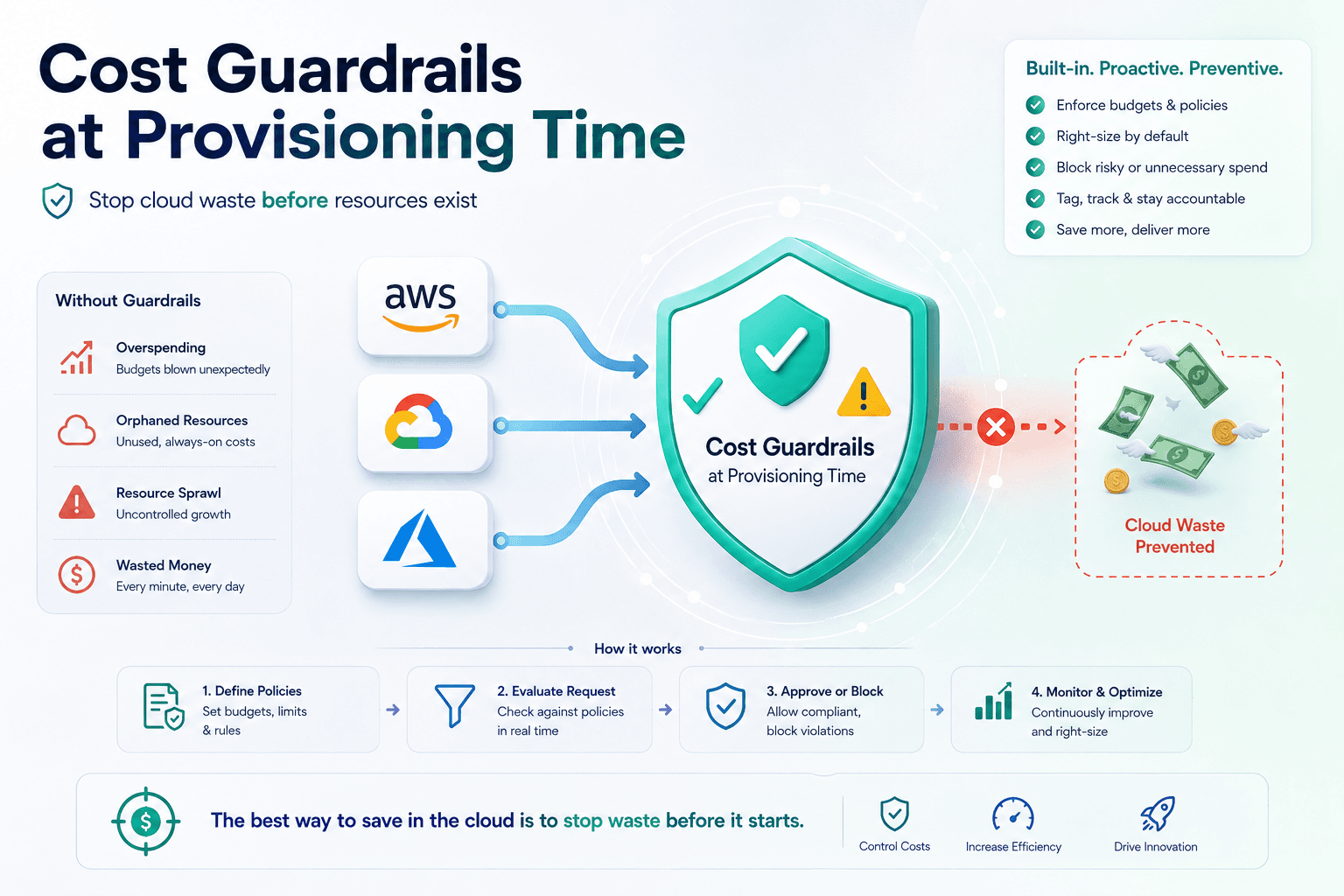
The cheapest cloud resource to fix is the one that never gets created wrong in the first place. Cost guardrails are automated policies that check every resource at the moment it is provisioned, before it starts billing, and either block it, resize it, or tag it for review. Teams that embed these checks into their platform report waste falling sharply within a single quarter, because the fix happens once, in the pipeline, instead of every month in a spreadsheet.
A guardrail is not a dashboard. Dashboards tell you what you already spent. A guardrail is a rule your infrastructure enforces on itself: no untagged resources, no GPU instances outside the ML account, no databases without an expiry date in dev. Engineers rarely notice them, which is exactly the point.
The bill review model has stopped keeping up
Flexera's 2026 State of the Cloud survey of more than 750 cloud decision-makers found that 29% of IaaS and PaaS spend is now wasted, the first rise in five years, driven largely by AI workloads. That reversal matters. The same survey shows 63% of organisations now run a FinOps team, yet waste climbed anyway. More people reviewing bills did not stop the leak.
The reason is timing. A monthly review catches an oversized instance thirty days after it started billing. With 81% of respondents using generative AI and GPU capacity priced at multiples of standard compute, thirty days of the wrong instance type is no longer a rounding error. Flexera has also found that 84% of organisations struggle to manage cloud spend at all, which suggests the review model was straining even before AI arrived.
What a provisioning-time guardrail actually looks like
The pattern is policy as code. You write cost rules the same way you write infrastructure, and the pipeline evaluates them on every plan. Three layers do most of the work.
First, hard blocks at the account boundary. AWS Service Control Policies can deny expensive instance families or regions organisation-wide, so the rule holds even when someone bypasses the pipeline. Azure Policy and GCP Organization Policies play the same role.
Second, pull request checks. Tools like Open Policy Agent evaluate Terraform plans against your rules, while Infracost posts the cost delta of a change directly in the pull request. An engineer who sees "this change adds 1,400 dollars a month" before merging will usually fix it themselves. No ticket, no review meeting.
Third, defaults in the platform. If your internal templates ship with right-sized instances, mandatory tags, and auto-expiry on non-production environments, engineers get the cheap path for free. This is where cloud and DevOps engineering work pays for itself, because good defaults compound across every team that uses them.

The chart is illustrative, but the shape is the argument: review-based cleanup lets waste accumulate between cycles, while guardrails flatten the curve from the first sprint.
Ninety days is a realistic horizon, with a caveat
Vendor and platform engineering write-ups commonly claim waste reductions of a third to a half within 90 days of embedding guardrails. Treat those figures as directional rather than audited, since they come from practitioner reports, not independent studies. What is well evidenced is the intent behind them: the FinOps Foundation's State of FinOps 2025 found workload optimisation and waste reduction was the top priority for 50% of practitioners, and its framework explicitly treats policy and governance as a core capability rather than an afterthought.
A sensible first quarter looks like this: weeks one to three, enforce tagging and surface cost deltas in pull requests. Weeks four to eight, add blocking policies for the ten most expensive misconfigurations in your own bill. Weeks nine to twelve, move the rules into shared templates so they apply by default. Measure against your own baseline, not a vendor's headline.
FAQ
Will guardrails slow my engineers down?
Done well, they speed things up. A blocked plan with a clear error message resolves in minutes; a cost escalation raised a month later needs meetings, archaeology, and rework. The goal is fewer decisions for engineers, not more approvals.
Do we need a FinOps team before adding guardrails?
No. Guardrails are an engineering control, and a small platform team can ship the first policies in a sprint. A FinOps function helps you decide which rules matter most, but waiting for one just extends the leak.
Your first five guardrails
1. Require cost-allocation tags on every resource, enforced at plan time.
2. Post cost deltas on every infrastructure pull request.
3. Block GPU and premium instance families outside approved accounts.
4. Auto-expire non-production environments after a set number of days.
5. Deny unattached storage volumes and idle load balancers at creation.
If your cloud bill is growing faster than the product it funds, BeyondPixl Studio can run a guardrail sprint on your estate: a 90-day plan built from your own billing data, with the first blocking policies live in your pipeline by week three. Book a cost guardrail assessment and see where the leak actually is.