
Most startups do not fail because their architecture could not scale. They fail because the product never earned the traffic that would have tested it. A startup really needs two architectures: a deliberately simple one for finding product-market fit, and a more structured one that arrives as customers force the issue. This guide uses AWS as the reference point, since 53% of organisations run significant workloads there according to Flexera, but the reasoning applies to any provider.
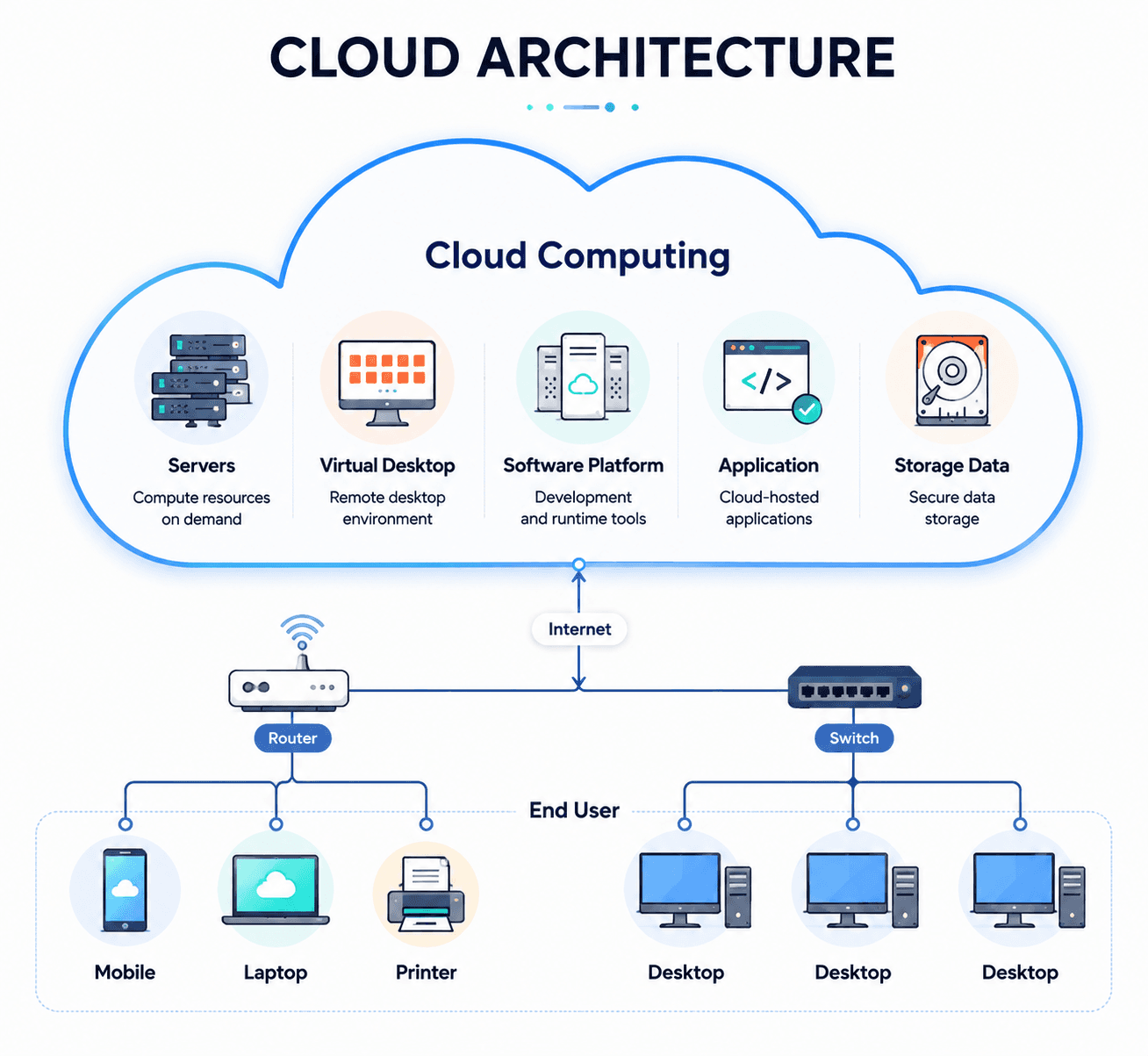
Cloud architecture for a startup is the arrangement of a provider's compute, storage, database, and networking services into a system that runs the product, plus the operational layer that deploys, monitors, and pays for it. A good architecture matches its complexity to the company's current stage and keeps the expensive decisions reversible for as long as possible.
Only two kinds of decisions deserve real design time
A rewrite later will freeze feature work for months, so sort decisions into reversible and irreversible before you commit engineering time. Two categories are genuinely hard to undo. The first is data: your primary database engine and how records are shaped. The second is contracts: your public APIs and event schemas, which customers and internal services build against. Almost everything else, from instance sizes to your container orchestrator, can be changed later without customers noticing.
Before provisioning anything, apply for credits. AWS Activate offers eligible startups up to $100,000, and Google and Microsoft run comparable programmes.
Boring technology wins the zero-to-one stage
With fewer than ten engineers, every hour spent operating infrastructure is an hour not spent learning what customers want. The right early system is one deployable application in a familiar framework, a managed Postgres on Amazon RDS or Aurora with Multi-AZ and automated backups, S3 for objects, and managed services for everything else. Among the compute options, Fargate and Lambda carry the lowest operational burden for small teams, while running your own Kubernetes cluster is overkill below roughly fifteen engineers.
Serverless is now a mainstream default. Datadog's State of Serverless research found that over 70% of its AWS customers run at least one serverless solution, and it means close to zero infrastructure management at the cost of tighter coupling to AWS. Most early startups should accept that trade willingly, and keep security basics in place from day one: separate accounts for prod, MFA on root, least-privilege IAM, and tested database restores.
Cost is a design input, not a billing surprise
Flexera's 2025 survey found that 84% of organisations name managing cloud spend as a top challenge, with budgets exceeded by 17% on average. The chart below shows how widespread the pressure has become.

A startup cannot staff a FinOps function, but it can build cloud cost optimisation into the architecture from the first resource. Tag everything by service and environment, set billing alerts before you deploy anything, prefer scale-to-zero services so quiet hours cost nothing, and shut down non-production compute overnight. Most cost failures are design failures, fixed on the whiteboard, not in the invoice.
Kubernetes and scaling can wait until the team forces them
The CNCF's 2025 annual survey puts production use at 82% of container users, but that is an argument for eventual adoption, not early adoption. Adopt it once several teams deploy independently across ten or more services, or once workloads such as GPUs arrive that Fargate handles poorly. Until then, ECS on Fargate or Lambda does the same job with far less surface area, and containers built for ECS later move to EKS without a rewrite.
Past the first thousand customers, the bottleneck shifts to whether the team can change the system safely. Google's DORA research, reconfirmed in its 2025 report, shows that teams deploying more frequently also fail less often and recover faster. Define every resource with infrastructure as code in Terraform or CDK, and build CI/CD pipelines that take every merge to production with automated tests and rollback. The scaling mechanics then arrive as well-understood bolt-ons: a CDN, read replicas, a Redis cache, and queues to flatten traffic spikes.
FAQ
What is the best cloud architecture for an early-stage startup?
A managed monolith: one application on Fargate or Lambda, managed Postgres with Multi-AZ and tested backups, S3 for objects, and a CDN in front. Defer Kubernetes and microservices until team size forces the question.
Is serverless a sensible default for startups?
Yes, for most web and API workloads, since pay-per-request pricing means a pre-traction product costs almost nothing. Latency-critical or long-running workloads are the main exceptions.
Your zero-to-scale checklist
Apply for cloud credits before building anything.
Choose boring compute, Fargate or Lambda, with managed Postgres, Multi-AZ, and tested restores.
Define every resource as code from the first commit, with automated deploys and rollback.
Tag all resources, set low billing alerts, and schedule non-prod shutdowns.
Re-evaluate Kubernetes only when multiple teams, many services, or special workloads force it.
The startups that scale smoothly are the ones whose infrastructure stayed boring long enough for the product to become interesting. At BeyondPixl Studio we design and build these architectures for startups every week. Talk to our engineering team about a staged architecture review before your next funding round