
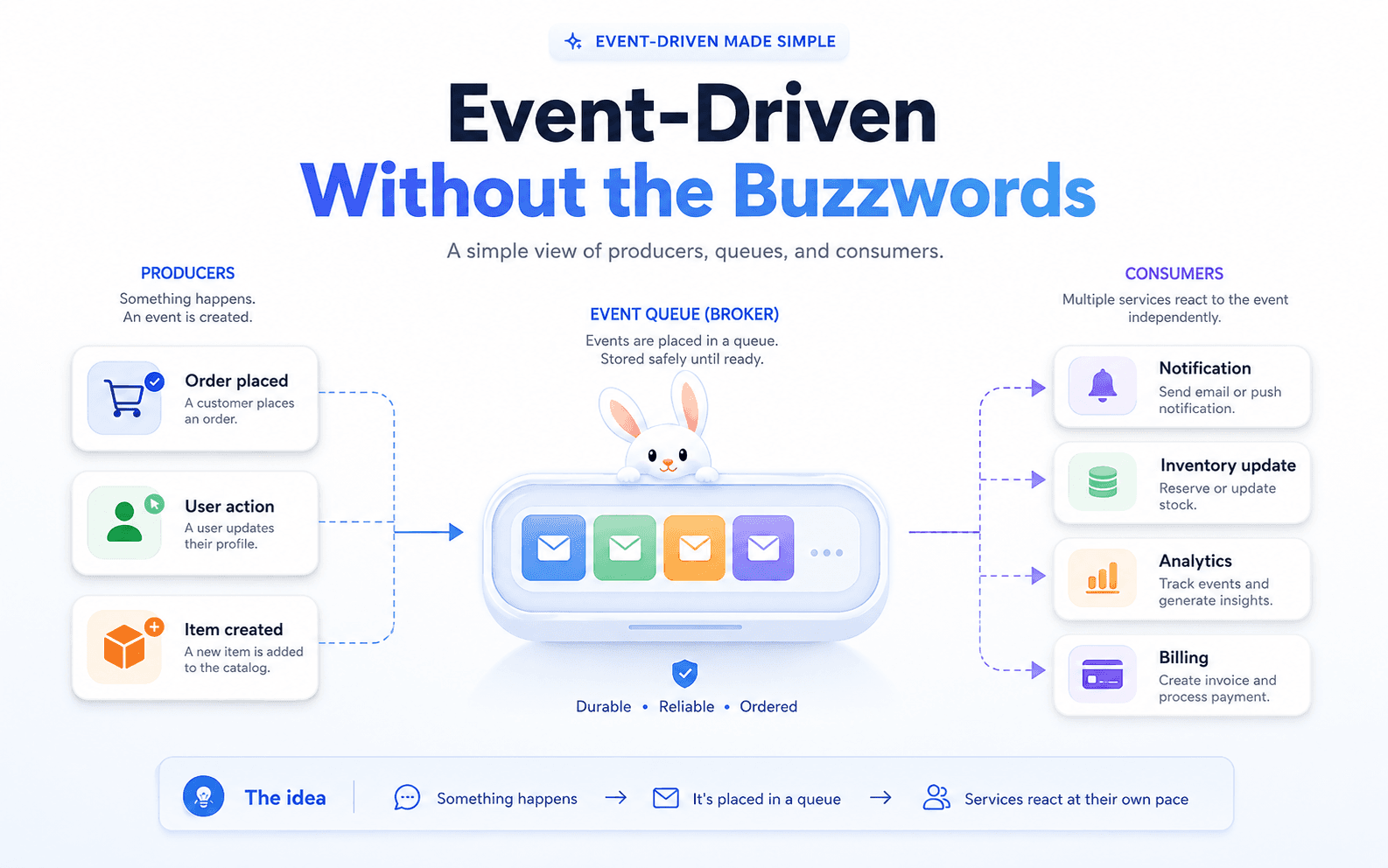
Event-driven architecture means one thing: instead of service A calling service B and waiting for a reply, service A announces that something happened and moves on. Whoever cares about that announcement reacts in their own time. That is the whole idea, and everything else is plumbing in service of it.
A quick definition for the record. An event is a small, factual message that something occurred: an order was placed, a payment cleared, a user signed up. Event-driven architecture (EDA) is a way of wiring systems together where services publish these facts to a shared channel and other services subscribe to the ones they need, with no direct calls between them.
Why teams keep ending up here
Nobody adopts EDA for the vocabulary. They adopt it because synchronous chains break in predictable ways. When checkout calls inventory, which calls pricing, which calls a tax service, the whole chain is only as available as its weakest link, and every added call stretches response time for the user standing at the till.
Put a queue in the middle and the pressure changes shape. Checkout writes one event and responds to the customer immediately. Inventory, invoicing and email each consume that event independently. If the email service falls over for twenty minutes, orders keep flowing and the emails catch up later. That decoupling is why 72% of global businesses now use event-driven architecture in some form, according to Solace's survey of enterprise IT professionals, and why more than 80% of Fortune 100 companies run Apache Kafka, the most widely deployed event streaming platform.
The same survey carries a warning worth hearing early: only 13% of those organisations have applied EDA consistently across the business.
The three moves that cover most real systems
Strip away the conference talks and most production event-driven systems use three patterns, well described in Martin Fowler's essay on what event-driven actually means.
First, event notification. A service announces a fact and forgets about it. This is your order confirmation email, your analytics ping, your cache invalidation. A managed queue such as Amazon SQS or RabbitMQ handles this with very little ceremony.
Second, background processing. Anything slow, a PDF render, a video transcode, a bulk import, gets pushed onto a queue so the user is not left watching a spinner. The chart below shows the mechanism: traffic arrives in spikes, but workers drain the queue at a steady rate you control, so you provision for the average rather than the peak.

Third, coordinating multi-step work. When an order touches payment, stock and shipping, each step emits an event that triggers the next, with a compensating action if something fails partway. This is the saga pattern, and it is how you get reliable workflows without a distributed transaction.
Where it goes wrong, and when to say no
The honest failure modes are not technical exotica. Events arrive twice, so consumers must be idempotent, meaning that processing the same message again changes nothing. Events arrive out of order, so consumers cannot assume sequence. And debugging shifts from reading one stack trace to tracing a story across services, which is why AWS's own builders' library on queue backlogs spends most of its pages on monitoring and recovery rather than happy paths.
So say no when the caller genuinely needs the answer now. A price calculation, an authentication check or a stock lookup should stay a plain synchronous call. Say yes when work can happen later, when several services care about the same fact, or when spiky load keeps forcing you to over-provision. Teams often bring us in at exactly this fork, and it is the core of our event-driven and background processing work within backend engineering.
FAQ
Do I need Kafka to be event-driven?
No. Kafka earns its complexity when you need replayable history or very high throughput. A managed queue like SQS, Google Pub/Sub or RabbitMQ covers most teams for years.
Is event-driven architecture only for microservices?
No. A monolith with a job queue for slow work is already event-driven where it matters, and it is often the best first step.
What is the difference between a queue and an event stream?
A queue hands each message to one worker and deletes it. A stream keeps an ordered log that many consumers can read independently, and replay from any point.
Before you adopt EDA, do these five things
1. List which operations truly need an immediate answer and keep those synchronous.
2. Pick one slow, user-facing task and move it to a background queue as a pilot.
3. Make every consumer idempotent before you scale the pattern.
4. Agree event names and payload shapes in a written contract, however small.
5. Set up dead-letter queues and queue-depth alerts on day one, not after the first incident.
If you are staring at a tangle of synchronous service calls and wondering which seams to cut first, BeyondPixl Studio runs short architecture reviews that map your workloads to the right mix of queues, streams and plain API calls. Book a backend architecture review and get a prioritised migration plan within a week.