
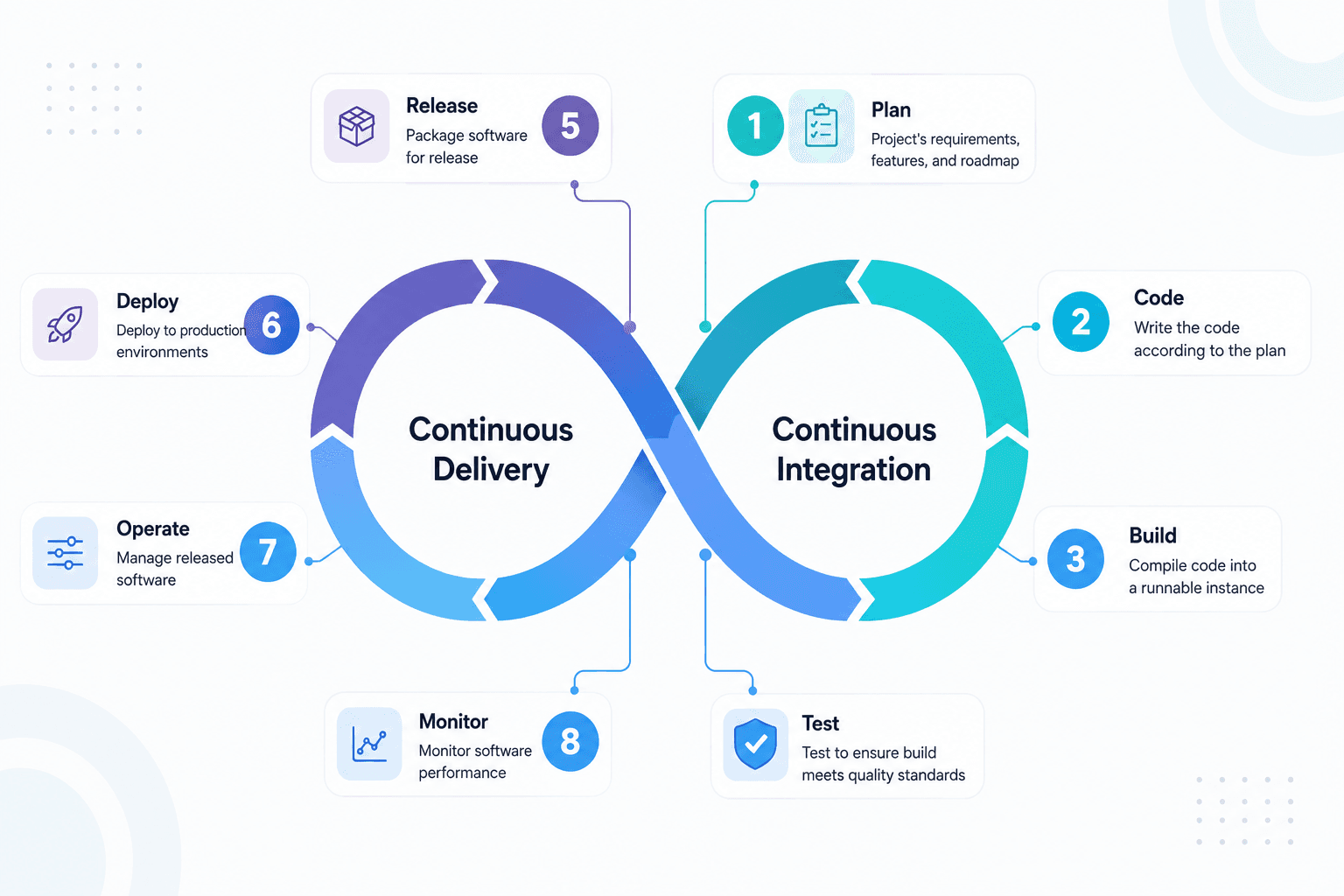
Most engineering teams already run a pipeline, but far fewer trust it enough to deploy on a Friday afternoon. That gap in confidence is rarely a tooling problem; the difference comes down to a handful of design decisions that most organisations never make deliberately, and this guide walks through each one with benchmark data.
What a working CI/CD pipeline setup actually means
A CI/CD pipeline is an automated workflow that moves code from commit to production through defined gates: build, test, package and deploy. Continuous integration means merging small changes frequently and verifying each one automatically; continuous delivery means every change that passes those gates is releasable without manual steps. If the path to production still involves a person copying files or clicking through a console, you have manual deployment with extra steps, and a 2 a.m. incident will expose the difference.
The 2024 benchmark data shows the industry going backwards
The DORA 2024 State of DevOps report remains the best available benchmark for delivery performance. Elite teams deploy on demand, keep lead time under a day and recover from failed deployments in under an hour, and analysis of the 2024 DORA data shows elite performers deploying 182 times more frequently than low performers with a change failure rate roughly 8 times lower.
The distribution moved the wrong way, though: Octopus Deploy's review of the 2024 performance clusters shows the high tier shrinking from 31% to 22% while the low tier grew from 17% to 25%, and only 19% of teams reached elite level.

One plausible cause is AI-assisted code volume outpacing pipeline discipline, since the same DORA report linked rising AI adoption to an estimated 1.5% drop in delivery throughput and a 7.2% drop in delivery stability.
Slow pipelines usually mean dishonest test suites, not the wrong tool
When deploys are slow, the test suite is almost always the reason. The first failure mode is flaky tests, which train engineers to press rerun without reading the output. JetBrains' guide on flaky tests notes that they slow the pipeline and erode confidence in the whole testing process.
The second is an inverted test pyramid. Suites dominated by end-to-end browser tests are slow and brittle, so push assertions down the stack and keep a thin end-to-end layer for critical journeys. A useful budget is 10 to 15 minutes for pull request feedback; beyond that, engineers batch changes and merge less often, which drags down every DORA metric.
Tool choice matters far less. The JetBrains State of Developer Ecosystem data puts GitHub Actions at 33% organisational adoption, Jenkins at 28% and GitLab CI at 19%. What predicts success is whether pipeline configuration lives in version control and whether a named team owns the platform. Treat pipeline definitions the way you treat infrastructure as code: reviewed, versioned and deliberately boring.
Separating deploy from release decides whether the pipeline survives contact
The single most valuable safety change for most teams is decoupling deploy from release. A deploy moves code onto servers, while a release exposes new behaviour to users; when the two happen in the same moment, every deploy gambles with your entire user base. Trunk-based development, documented at trunkbaseddevelopment.com, keeps branches short-lived, feature flags let dormant code sit in production until you enable it gradually, and canary releases compare error rates on a small traffic slice before full rollout.
Rollback deserves the same rigour, because the elite benchmark of recovery in under an hour, per DORA, is unreachable if rollback is a wiki page. Keep the previous artefact one action away, write backward-compatible database migrations, and gate rollout stages with health checks that halt automatically. Security matters just as much, because the pipeline holds production credentials: pin third-party actions to commit SHAs rather than mutable tags, replace long-lived cloud secrets with short-lived OIDC-federated tokens, and scope runner permissions per job.
FAQ
How long should a CI pipeline take?
Pull request feedback should arrive within 10 to 15 minutes. Slower than that, engineers batch changes and merge less often, which raises risk. Longer suites such as full regression tests can run after merge instead.
What are DORA metrics and why track them?
DORA metrics are four measures of delivery performance: deployment frequency, lead time for changes, change failure rate and failed deployment recovery time. DORA's research links them to organisational performance, and they are best derived from pipeline events rather than surveys.
A checklist to run this quarter
Pull your four DORA metrics from the last 90 days of pipeline and incident data, not from memory.
Get pull request feedback under 15 minutes, and quarantine flaky tests out of the blocking path.
Move all pipeline configuration into version control and review it like application code.
Adopt trunk-based development and add feature flags for user-facing work.
Automate rollback and harden the pipeline with pinned dependencies, short-lived OIDC credentials and scoped runner permissions.
None of this needs a platform migration, only someone who treats the pipeline as a product whose users are your engineers. At BeyondPixl Studio we design and build production-grade delivery platforms for startups and enterprises, so if your pipeline runs but does not work, talk to our engineering team about a pipeline assessment.