
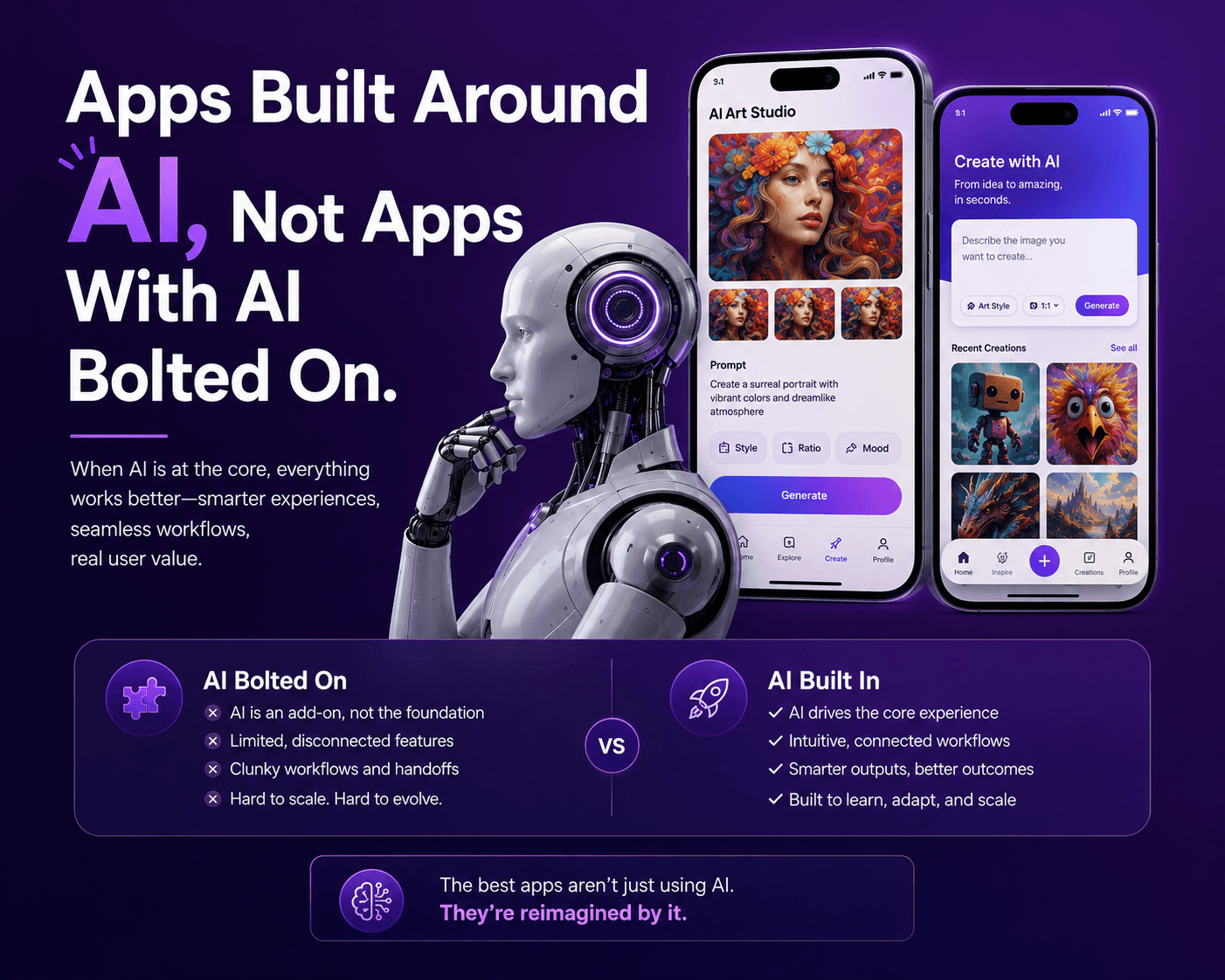
The difference between an app with AI and an app built around AI is architectural, not cosmetic. A bolted-on assistant sits in a corner of an existing interface and calls an API when tapped. An AI-first app makes the model the engine: the interface, the data flows and the backend are all designed around what the model needs to do its job well.
Consumers spent $167 billion on in-app purchases in 2025, and for the first time non-gaming apps out-earned games, a shift Sensor Tower attributes largely to generative AI services. AI apps grew downloads 148 per cent year on year, and ChatGPT finished as the third highest grossing app of 2025.
The bolt-on pattern fails quietly, then all at once
Most teams added AI the cheap way in 2023 and 2024: a chat bubble, a "summarise" button, a thin wrapper over someone else's API. The trouble is that these features carry no advantage: the model is available to every competitor, and the app's own data never improves the experience.
The revenue data shows how brutal this winner-takes-most dynamic is. In the first half of 2025, ChatGPT alone captured 63 per cent of all generative AI app revenue, earning more than twelve times its nearest competitor. If your AI feature is a worse version of a general assistant, users will simply use the general assistant. Gartner goes further, predicting that mobile app usage will fall 25 per cent by 2027 as AI assistants absorb tasks apps used to own. Apps that are thin wrappers around a model are the first to be absorbed.

Data from Sensor Tower's State of AI Apps report, covering nearly $1.9 billion of in-app purchase revenue in H1 2025.
What actually changes when AI is the architecture
An AI-first app makes three commitments a bolt-on never does. First, the interface is built for probabilistic output: streaming responses, visible confidence, easy correction, and undo everywhere, because the model will occasionally be wrong.
Second, your proprietary data becomes part of the product loop. The app captures context, retrieves the right slice of it for each request, and feeds outcomes back to improve results. That loop is the defence a wrapper lacks, because a competitor can copy your prompt but not your data.
Third, inference placement becomes a first-class decision. Both platforms now ship on-device models: Apple opened its Foundation Models framework to third-party developers, and Android exposes Gemini Nano through ML Kit and AICore. On-device handles fast, private, offline tasks; the cloud handles heavyweight reasoning. That split shapes latency, cost per user and privacy posture, so it belongs in the architecture phase.
The hardware is ready before most roadmaps are
The devices in your users' pockets are ahead of most product plans. Gartner expects worldwide spending on generative AI smartphones to reach $298 billion by the end of 2025, with neural processing units standard in nearly all premium handsets. The capability gap is no longer silicon; it is app architecture that still treats AI as a feature request.
For teams shipping on both platforms, this is also where cross-platform strategy earns its keep. A shared Flutter or React Native codebase with a well-designed native bridge to each platform's on-device models gives you one product surface and two sets of hardware acceleration. That design work sits squarely within cross-platform mobile development done properly, rather than being patched in later.
FAQ
Does AI-first mean rebuilding my existing app?
Usually not. It means picking one core workflow, redesigning it around the model with a real data loop, and measuring retention against the old flow. If the loop wins, the rest of the app follows incrementally.
Is on-device AI good enough to matter yet?
Yes, for a specific class of tasks. Summarisation, classification, proofreading and image description now run locally on recent iPhones and Android flagships with zero marginal cost and no data leaving the device. Complex multi-step reasoning still belongs in the cloud, so most serious apps use both.
Will AI assistants make standalone apps obsolete?
Gartner's forecast of a 25 per cent drop in app usage by 2027 targets shallow, interchangeable apps. Apps with proprietary data, a distinct workflow and a feedback loop become more valuable, because assistants need somewhere trustworthy to route those tasks.
Before you brief a team, check these five things
1. Identify the one workflow where a model plus your data beats a general assistant.
2. Map which data you already collect that could feed a retrieval and feedback loop.
3. Decide the on-device versus cloud split for each AI task, with latency and privacy budgets.
4. Design the interface for probabilistic output, including correction and undo paths.
5. Set a unit-economics ceiling for inference cost per active user before writing code.
If you want a second pair of eyes on that list, BeyondPixl Studio runs AI-first architecture reviews for mobile products, mapping your data, model placement and cross-platform approach into a build plan you can cost. Book an architecture review and arrive at your next planning cycle with the hard decisions already made.