
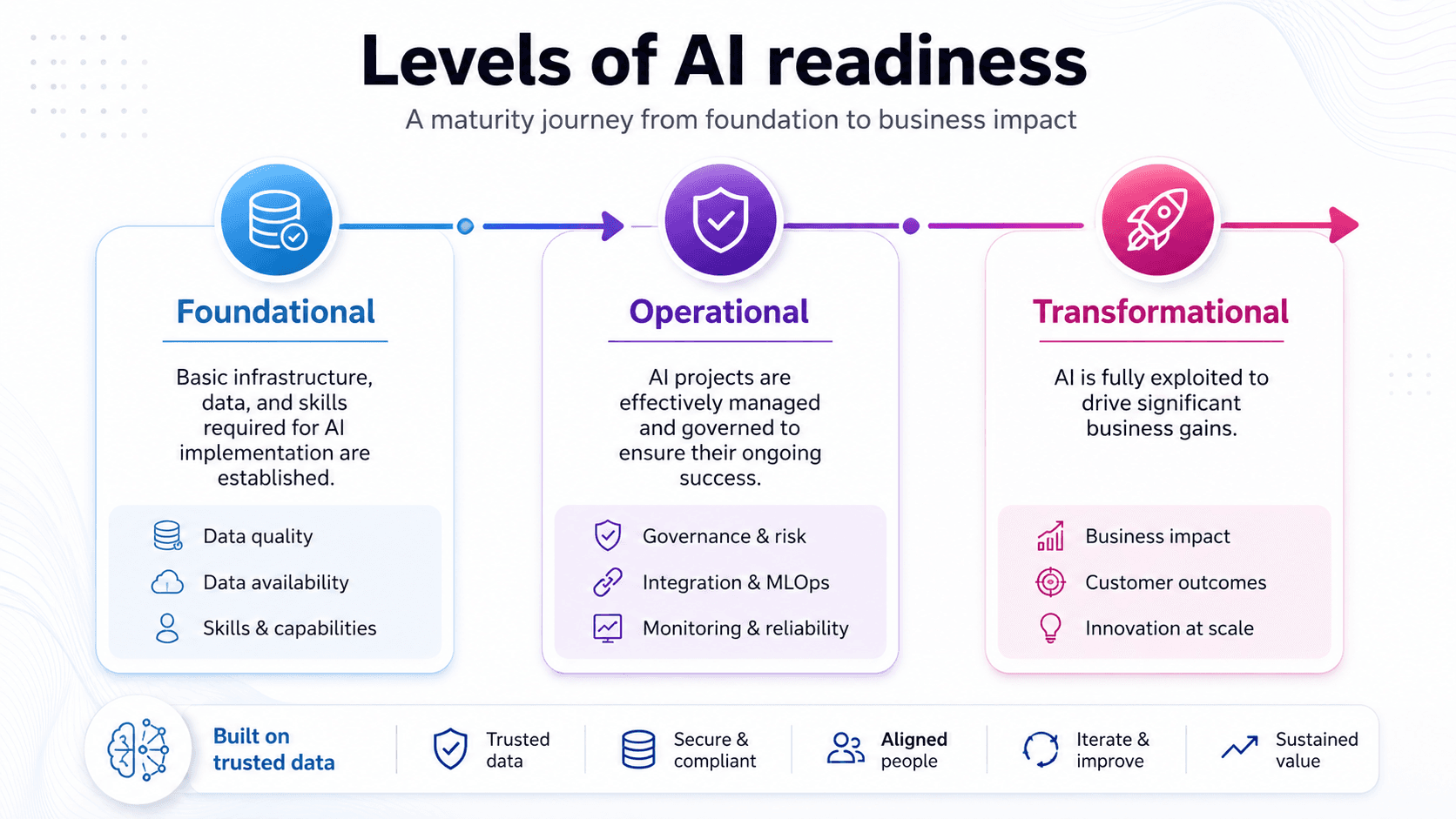
Here's the uncomfortable answer up front: if you can't say who owns each dataset, how fresh it is, and whether the answers your AI needs actually live in it, your data isn't ready. Gartner predicts that through 2026, organisations will abandon 60% of AI projects that aren't supported by AI-ready data. The model is rarely the problem. The pipeline feeding it usually is.
AI-ready data, in plain terms, is data that is aligned to a specific use case, governed by someone accountable for it, and delivered through pipelines with quality checks. IBM's definition adds a useful test: readiness is measured against the use case, not in the abstract. There is no such thing as generically ready data.
Most teams overestimate their readiness
The gap between confidence and reality is well documented. In Gartner's survey of 248 data management leaders, 63% said they either don't have, or aren't sure they have, the right data management practices for AI. That's nearly two thirds of the people whose job is data admitting they can't vouch for it.

The downstream cost shows up in pilot graveyards. MIT's GenAI Divide report found that 95% of enterprise generative AI pilots fail to deliver measurable financial returns, and the barriers it identified were organisational rather than technological. The headline number has its critics, but nobody disputes the direction: pilots stall on context, integration and data plumbing, not on model quality.
The blind spot is almost always unstructured data
Ask a CTO about data readiness and they'll describe their warehouse. But the AI you probably want runs on the messy stuff: emails, PDFs, tickets, contracts, call notes.
That's exactly where readiness collapses. In a December 2025 Harvard Business Review Analytic Services survey of 325 executives, 65% said their structured data was at least somewhat prepared for AI, but only 39% could say the same about their unstructured content. And while 94% agreed that well-connected data and processes are critical to AI success, just 27% said their organisation actually has that today.
So the honest readiness question isn't "is our data clean?". It's "is the specific data this use case needs findable, current, permissioned and connected?". Four different questions, and most teams have only ever audited the first.
A readiness check you can run this week
You don't need a six month data programme before you learn anything. Pick your single most wanted AI use case and interrogate it:
Coverage: does the data to answer this question exist anywhere in your systems, or does it live in people's heads? If your best support agent's knowledge isn't written down, no retrieval system can find it.
Quality and freshness: sample 50 records. How many are duplicated, stale or contradictory? An AI that confidently serves last year's pricing is worse than no AI at all.
Access and lineage: can a system, not a person, reach this data through an API or pipeline? And when a field looks wrong, can anyone trace where it came from?
Ownership: name the individual accountable for each source. Gartner's research suggests most failed projects die here, because nobody owned the governance that makes data trustworthy.
Scoring a use case against those four lenses takes days, not quarters, and it's the first exercise we run in AI strategy and use-case discovery engagements, because it cheaply kills bad ideas before they cost real money.
FAQ
What is AI data readiness?
AI data readiness means your data can support a specific AI use case: it's relevant to the task, accurate, current, accessible through pipelines, and governed by a named owner. Readiness is always judged per use case, never as a general property of your data estate.
How long does an AI readiness assessment take?
A focused assessment of one or two use cases takes one to two weeks. A full data estate audit takes months, so start narrow and let one use case expose the systemic gaps.
Can we start an AI project with imperfect data?
Yes, if you scope around the gaps. A pilot built on your cleanest, best-owned dataset teaches you far more than a stalled programme waiting for perfect data. Just don't aim a customer-facing assistant at data nobody has audited.
Your five step self assessment
1. Write down your top AI use case as a question the system must answer.
2. List every data source needed to answer it, and name an owner for each.
3. Sample 50 records per source and score duplication, staleness and contradictions.
4. Confirm each source is reachable by API or pipeline, with access permissions mapped.
5. Rate each source red, amber or green, and only build where you see green.
More red than green is a finding, not a failure. BeyondPixl Studio runs structured AI readiness assessments as part of its discovery work, mapping exactly which of your use cases your data can support today and what the shortest path is for the rest. Book a discovery call and bring your messiest dataset.