
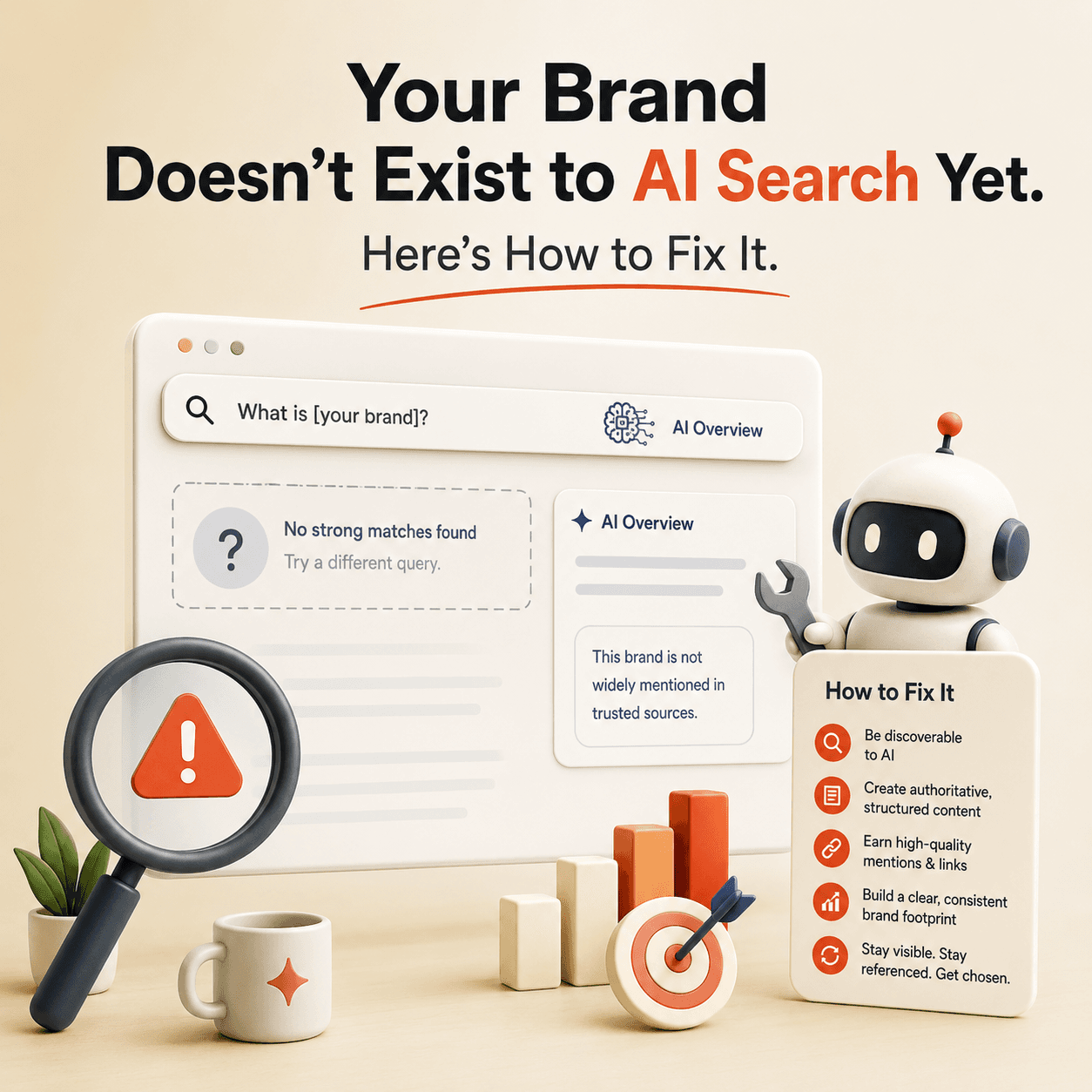
Ask ChatGPT or Perplexity to recommend a company in your category and see whether you appear. For most brands the honest answer is no, and the reason is uncomfortable: the pages that earned your Google rankings are not the pages AI assistants cite.
AI search visibility means being retrieved, quoted, and named when an assistant like ChatGPT, Gemini, Claude, or Google's AI Overviews composes an answer. It is related to SEO but scored differently, because these systems select sources for synthesis, not for a ranked list of links.
Ranking on Google no longer means being cited by AI
The evidence here is blunt. An Ahrefs study of 15,000 queries found that only 12 per cent of URLs cited by ChatGPT, Gemini, and Copilot rank in Google's top ten for the same query, and 80 per cent of cited pages don't rank anywhere in Google's top 100. Perplexity is the outlier at roughly 29 per cent overlap. One industry analysis published in May 2026 argues the overlap between top Google results and AI-cited sources has fallen from around 70 per cent to under 20, and while the methodology behind that headline is less transparent, the direction matches everything we can verify.
Meanwhile the audience is moving. Gartner predicted in early 2024 that traditional search volume would fall 25 per cent by 2026 as chatbots absorb queries. The full drop hasn't materialised on schedule, but the substitution is real: Similarweb data reported by TechCrunch shows AI platforms sent 1.13 billion referral visits to top websites in June 2025, up 357 per cent in a year. And Pew Research found that when an AI summary appears on Google, users click a result only 8 per cent of the time, against 15 per cent without one.

The chart anchors on Similarweb's verified June 2024 and June 2025 figures; the curve between them is illustrative.
Why AI systems can't see you
Assistants build answers from three inputs: their training data, a retrieval layer that fetches live pages, and structured knowledge about entities. Brands fail on all three.
First, ambiguity. If your site never states plainly what you do, who you serve, and where you operate, a model cannot summarise you confidently, so it names a competitor who did. Second, access. If your robots.txt blocks crawlers such as OpenAI's GPTBot, you have opted out of the citation pool entirely. Third, thin third-party evidence. Assistants lean on comparison pages, reviews, forums, and industry directories, and if you exist only on your own domain, you look unverifiable.
What actually moves the needle
Start by writing answer-shaped content: pages that pose the question a buyer asks and resolve it in the first hundred words, with specifics a model can quote. Add Organization schema so machines can parse who you are, connect your entity across LinkedIn, Crunchbase, and industry directories, and get named in the third-party sources assistants already trust.
Then measure it. Run your priority prompts through ChatGPT, Perplexity, and Gemini monthly, log who gets cited, and treat that list as your real competitive set. This is strategy work, not a plugin, and it sits naturally inside a broader AI strategy and adoption programme rather than a bolt-on to your existing SEO retainer.
FAQ
Is AI search optimisation different from SEO?
Yes, though they share foundations. SEO earns a position in a ranked list; AI visibility earns a citation inside a synthesised answer. Clear entity signals, quotable claims, and third-party corroboration matter far more for the latter, and the Ahrefs data above shows the two now reward largely different pages.
How do I check whether AI assistants can crawl my site?
Read your robots.txt for rules affecting GPTBot, ClaudeBot, PerplexityBot, and Google-Extended, then check your CDN or firewall settings, since some block AI crawlers by default. Blocked crawlers mean no retrieval, and no retrieval means no citations.
How long does it take to show up in AI answers?
Retrieval-based systems like Perplexity and ChatGPT search can cite new pages within days of indexing. Mentions baked into model training data take months and depend on how widely your brand appears across the wider web.
Your five-step fix
1. Prompt-test your brand across ChatGPT, Perplexity, and Gemini, and record who gets cited instead of you.
2. Audit robots.txt and your CDN so reputable AI crawlers can reach your content.
3. Add Organization and FAQ schema, and state plainly what you do on every key page.
4. Rewrite your highest-value pages to answer the buyer's question in the first hundred words.
5. Build third-party evidence: directories, reviews, comparisons, and expert commentary that mention you by name.
We diagnosed this exact gap on our own domain before writing about it, so we know where the quick wins hide. If you want the same diagnosis run on yours, BeyondPixl Studio offers an AI search visibility audit that maps where assistants source answers in your category and what it takes to be cited. Book the audit and get a prioritised fix list within two weeks.