
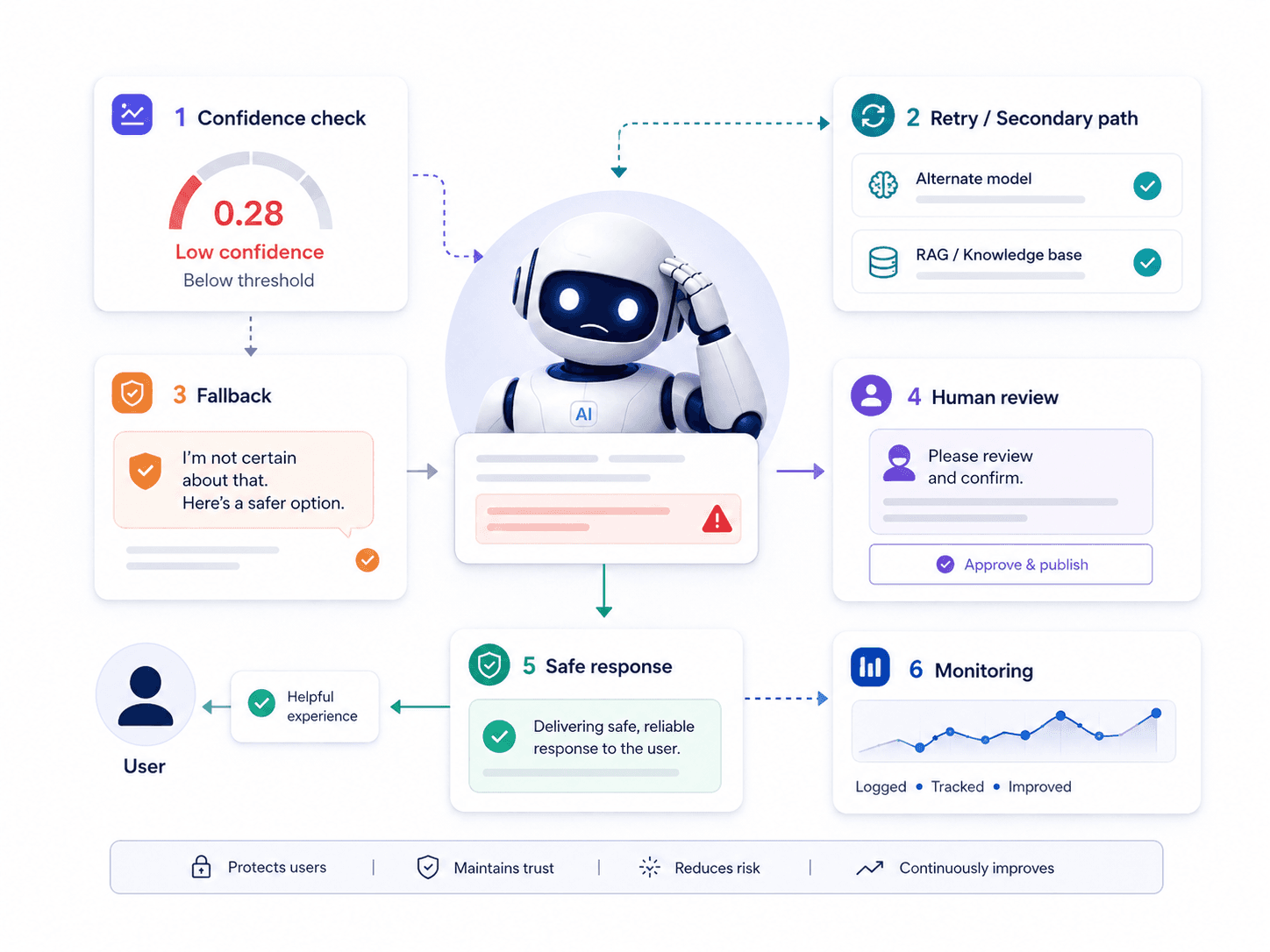
Your model will be wrong, and no amount of prompt tuning changes that. The engineering question is not how to reach zero errors but what your product does in the moment an error happens. A gracefully degrading AI feature detects low confidence, falls back to something safe, and makes every AI action easy to undo. A brittle one presents its worst guess with the same polish as its best answer, and lets the customer discover the difference.
Graceful degradation, borrowed from resilience engineering, means a system that loses accuracy or coverage under stress instead of failing outright. For AI products, it means designing the feature around the assumption that some outputs will be wrong, then deciding in advance where those wrong outputs are allowed to land.
The error rate is a property of the product, not a bug
Even frontier models fabricate a measurable share of grounded answers. Vectara's public hallucination leaderboard scores models on faithful summarisation of supplied documents, and rates range from under 2 per cent for the best entries to around 10 per cent for widely deployed general models. That is the floor, on a task where the correct answer is sitting in the context window.
What separates mature teams is not a lower error rate but a cheaper error. When Air Canada's chatbot invented a bereavement refund policy, a tribunal ordered the airline to honour it. When Cursor's support bot fabricated a one device login policy, users believed it and cancelled subscriptions within hours. In both cases the failure was not the hallucination. It was that a wrong answer travelled to a paying customer with full authority and no fallback in between.
Answer less, and answer better
The most useful engineering lever is selective prediction: let the system decline to answer when its confidence is low. Research such as SelectLLM formalises the trade off: raising the confidence threshold shrinks the share of requests the model answers but raises the accuracy of the answers it does give. You are choosing which of its outputs reach people.

The chart above is illustrative, but the mechanism is standard. Below the threshold, the feature does something boring and reliable instead: keyword search instead of generated answers, a template instead of drafted copy, a routed ticket instead of a bot reply. A support feature that answers 70 per cent of queries and hands the rest to a human beats one answering everything at 90 per cent accuracy, because the second manufactures ten confident failures per hundred conversations.
Design the failure path with the same care as the happy path
Two practitioner playbooks are worth keeping open. Google's People + AI Guidebook treats errors as a design material: identify error sources, decide which the user should even see, and pair every error with a path forward. Microsoft's HAX guidelines push the same discipline, including making clear what the system can do, showing why it did what it did, and supporting efficient correction and dismissal.
In practice that converts into four patterns. Show provenance, so users can check the source rather than trust the prose. Scale friction with stakes, so a low confidence output arrives as a suggestion needing confirmation rather than an executed action. Make everything reversible, with undo as a first class operation. And log the declines and corrections, because the queries your system refused or got overruled on are the cheapest training data you will ever collect. This is the unglamorous half of AI product engineering, and it is usually the half that decides whether a feature survives contact with customers.
FAQ
What does graceful degradation mean for an AI feature?
It means the feature has a planned, safe behaviour for when the model is wrong or unsure: declining to answer, falling back to a simpler system, or routing to a human, rather than presenting a bad output as fact.
How do I get a confidence signal from an LLM?
Options include token level log probabilities, self consistency checks across multiple samples, a separate verifier model, and retrieval grounding scores in RAG systems. None is perfect alone, so tune thresholds against a labelled test set rather than by instinct.
Does adding fallbacks make the product feel worse?
Usually the opposite. Users forgive a system that admits uncertainty far more readily than one that misleads them, and a single confident fabrication can undo months of correct answers.
Your graceful degradation checklist
1. Measure your real error rate on a labelled test set before launch, not after.
2. Set a confidence threshold and define the exact fallback behaviour below it.
3. Show sources and reasoning so users can verify instead of trust.
4. Make every AI initiated action reversible, with undo one click away.
5. Log declines, corrections and overrides, and feed them back into evaluation.
If you are shipping an AI feature and the failure path is still a blank space in the spec, BeyondPixl Studio runs focused AI product engineering engagements that design and build the confidence thresholds, fallbacks and recovery flows around your model. Book a failure mode review of your feature before your customers run one for you.