
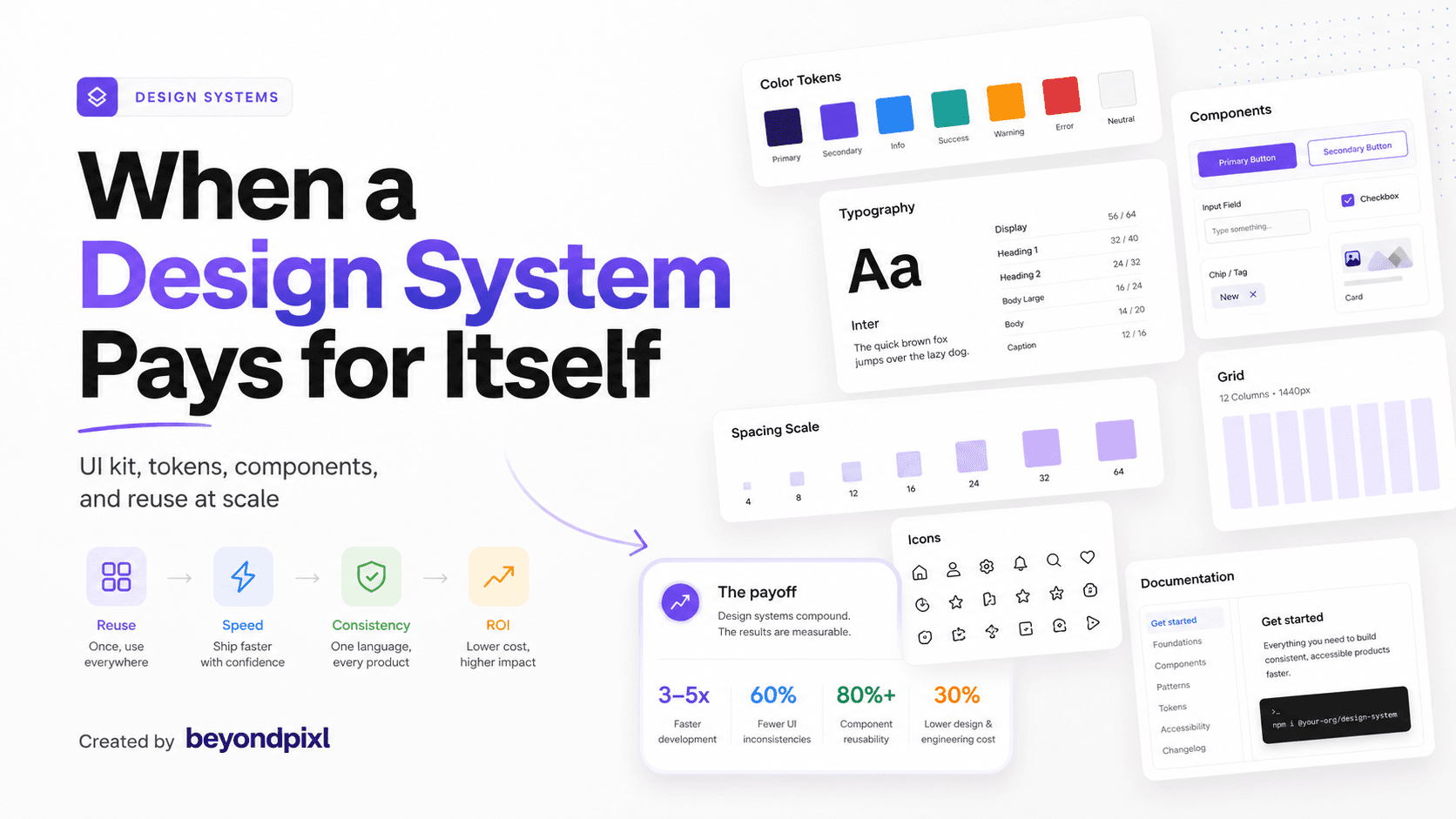
A design system pays for itself when the hours it saves on every new screen finally outweigh the hours it cost to build and maintain. For most product teams that crossover arrives somewhere between the third and the tenth feature that reuses the components, not on day one. Before that point it is a cost centre. After it, every button, form and modal you don't rebuild is compounding interest.
A design system is a shared library of coded components, design tokens and usage rules that designers and developers pull from instead of recreating UI by hand. It is the product behind your products.
The efficiency numbers are real, and surprisingly consistent
The best controlled evidence comes from Sparkbox's design system study, which had eight developers build the same form page twice: once from scratch, once with IBM's Carbon design system. The Carbon builds were 47% faster, with the median dropping from 4.2 hours to 2 hours, and that 2 hours included time spent learning the system. The top two submissions for visual consistency both came from the design system builds.
Company-scale numbers point the same way. In Figma's business case round-up, Grammarly found its design system saved design and development teams 25% of their working week, and Freshworks credited its system with a 28% reduction in customer service costs through faster ticket resolution.
Treat these as directional rather than a promise, because your gain depends on how much repeatable UI your roadmap contains. A team shipping its fifth dashboard benefits far more than a team building one bespoke marketing site.
The break-even question is really a volume question
The honest ROI model has three inputs: what the system costs to set up, what it costs to maintain, and how much each subsequent feature saves. Smashing Magazine's ROI formula walks through exactly this arithmetic; its worked example models roughly $646,000 invested returning about $1.5 million in time savings over five years, a 135% return.
The shape of that curve matters more than the exact figures. Early on, the system line sits above the scratch line because you are paying for tokens, components, documentation and reviews while shipping nothing new. The lines cross when reuse volume overtakes setup cost, and after that the gap widens with every release.

The chart above is illustrative, but the mechanism it shows is the one the Sparkbox study measured at the level of a single page: the saving is per use, so payback is a function of how often the components get used.
Most systems fail on adoption, not construction
In Sparkbox's 2022 industry survey, only around 40% of respondents rated their design system successful or very successful, and the recurring blockers were adoption, contribution and design-to-code drift rather than missing components. A beautifully documented library nobody imports has an ROI of exactly zero.
The systems that do pay back share a few habits. They treat the system as a product with an owner, not a side project. They publish components somewhere developers actually browse, such as Storybook. And they start from the screens teams are building this quarter rather than a speculative catalogue. This is where experienced frontend development partners earn their fee: the hard work is wiring the system into real delivery pipelines and real team habits, not drawing the buttons.
There is also a newer forcing function. If your team uses AI coding tools, a design system gives those tools a constrained vocabulary to generate from, which keeps machine-written UI on brand instead of merely plausible.
FAQ
How long until a design system pays for itself?
Typically once several product surfaces reuse the same components, often within 6 to 18 months for multi-product teams. The Smashing Magazine model shows returns compounding over a five-year horizon.
Is a design system worth it for a small team?
Usually not as a full programme. A small team gets most of the benefit from design tokens plus a dozen core components, and can extend an open system like Carbon instead of building from zero.
What should we measure to prove ROI?
Track time-to-build for comparable features before and after, component adoption rate across codebases, and UI defect counts. Speed, adoption and consistency together tell you whether the curve has crossed.
Your five-step payback checklist
1. Count the screens on your next two quarters of roadmap that share UI patterns; that is your reuse volume.
2. Price the setup honestly: tokens, 15 to 25 core components, documentation and governance time.
3. Pick a distribution home developers already use, and publish components there from week one.
4. Assign a named owner with time budgeted for maintenance and contribution review.
5. Measure build time on the first three features that consume the system, and compare against your baseline.
If you want a grounded answer for your own roadmap rather than someone else's case study, BeyondPixl Studio runs design system payback assessments that model your break-even point from your actual component reuse, then scopes the smallest system that crosses it. Book one before you commit a quarter of engineering time on faith.