
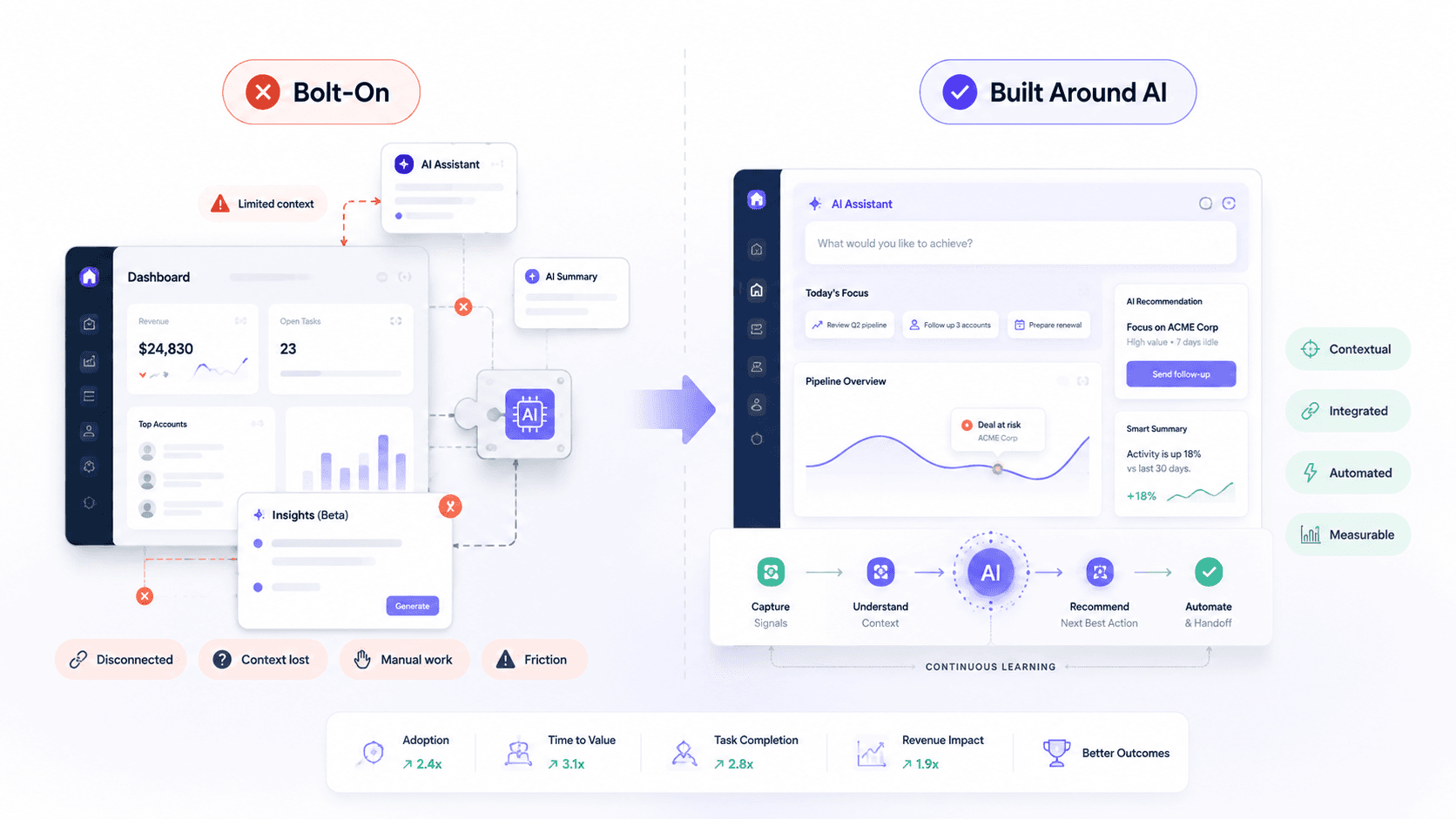
The short answer: AI placed on top of an existing workflow rarely moves a business number, while AI that the workflow is redesigned around usually does. McKinsey's research is unusually blunt on this point. Across every organisational change it measured, redesigning workflows had the biggest effect on whether gen AI produced EBIT impact, bigger than model choice, budget, or which vendor you picked. Yet only 21 percent of organisations using gen AI had redesigned any workflows at all. Most teams are still bolting.
A bolt-on deployment adds AI to a process that stays structurally identical: same steps, same handoffs, same approvals, now with a chatbot beside them. A rebuilt deployment asks what the process should look like if the model does the heavy lifting, then restructures steps, roles and checkpoints around that answer.
Bolt-on AI automates the steps you should have deleted
When you drop an assistant into an unchanged process, you inherit every inefficiency that process already had. The drafting step gets faster, but the four-person approval chain behind it still takes nine days. You have optimised the ten percent of cycle time that was never the bottleneck.
MIT's GenAI Divide study of 300 enterprise deployments found that 95 percent of pilots delivered no measurable profit-and-loss impact, and pinned the cause on integration, not model quality. The tools that failed were, in the researchers' words, slick in demos and brittle in workflows. Meanwhile 90 percent of employees were already using personal AI tools at work, which tells you the appetite exists; the official deployments simply sat in the wrong place.
Boston Consulting Group frames the same finding as a budget ratio. Its research on AI programmes found that roughly 70 percent of implementation challenges come from people and process issues, 20 percent from technology, and only 10 percent from the algorithms themselves. Companies that spend their effort in the opposite proportions, all model and no process, are funding the smallest slice of the problem.
The adoption numbers and the value numbers tell two different stories
Put the survey data side by side and the pattern is hard to miss. Usage is nearly universal; structural change and profit impact are rare.

McKinsey found 78 percent of organisations using AI in at least one function, but only 21 percent redesigning workflows. MIT found 90 percent of staff using AI personally, but 5 percent of official pilots reaching profit-and-loss impact (sources: McKinsey and MIT via Fortune). The gap between those pairs of bars is the bolt-on gap.
Rebuilding does not mean rebuilding everything
The word "rebuilt" scares operations leaders because it sounds like a two-year transformation programme. It is not. The successful pattern in BCG's impact research is narrow and deep: pick one end-to-end workflow, invoice processing, tier-one support triage, quote generation, and redesign that single flow around the model.
In practice that means three moves. First, map the current process honestly, including the informal steps nobody documents. Second, decide which steps the model owns outright, which it drafts for human review, and which disappear entirely. Third, rewire the checkpoints so humans review exceptions rather than everything, because a reviewer who must approve 100 percent of outputs is just the old bottleneck wearing a lanyard that says AI.
This is exactly the discovery-and-redesign work an AI automation for operations engagement should start with, before any model gets chosen. Teams that skip it end up choosing very good models for very bad processes.
FAQ
Is bolt-on AI ever the right choice?
Yes, for low-stakes individual productivity: meeting notes, first drafts, code suggestions. Bolt-on tools pay for themselves at the personal level. They fail when you expect them to move an operational metric such as cycle time, cost per case or error rate, because those metrics live in the process, not the task.
How do I know if our deployment is bolted on?
Ask one question: did any step, role or approval change when the AI arrived? If the process map looks identical to last year's with a chatbot icon added, it is bolted on, and the McKinsey evidence says the EBIT impact will probably not arrive.
How long does a workflow rebuild take?
For a single well-scoped workflow, typically six to twelve weeks from process mapping to a redesigned flow in production, far shorter than most stalled pilots have already been running.
Your next five steps
1. Pick one workflow with a measurable business number attached, not a department.
2. Map it as it actually runs today, including the undocumented workarounds.
3. Decide step by step what the model owns, what it drafts, and what gets deleted.
4. Move human review to exceptions only, with clear escalation rules.
5. Set the baseline metric before launch so impact is provable, not argued about.
If you would rather run that exercise with people who have done it before, BeyondPixl Studio runs workflow redesign sprints that take one operational process from map to redesigned, AI-native flow. Book a workflow audit and we will tell you within a week whether your candidate process is worth rebuilding.